

What to Do About a Roof Leak After a Storm in South Florida
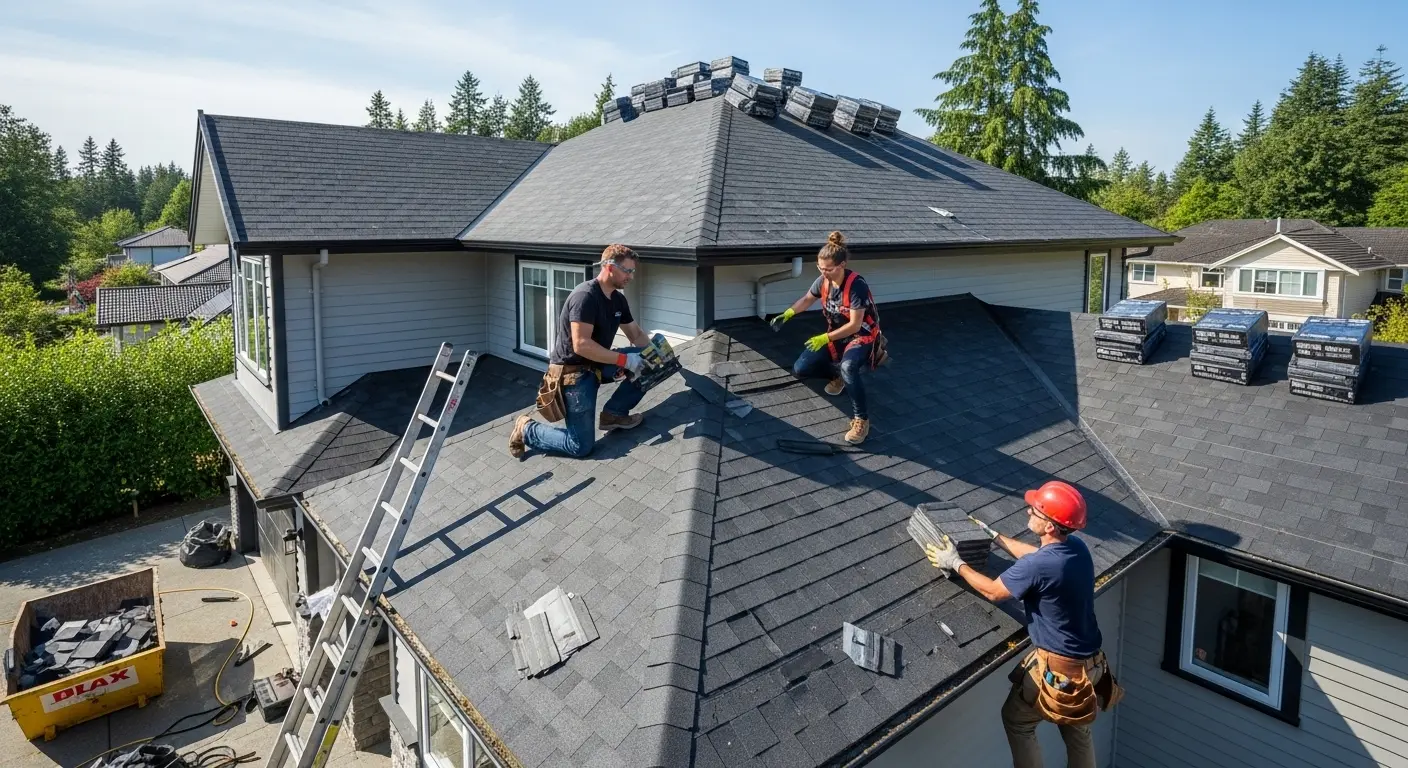
It usually starts small. A brown ring on a ceiling that was not there yesterday, a dark seam along the top of a wall, or a steady tick of water into the hallway. The storm has already moved off toward the Gulf and your roof looks fine from the driveway, but something up there moved and the next band of rain found it.
What you do in the next two days decides two separate things: how much of the inside of your house you save, and how much of the repair your carrier ends up paying for. Those are not the same problem, and homeowners routinely handle the first one well and the second one badly.
This is the order we would work it, written for someone standing under a dripping ceiling with a bucket, not for an adjuster.
The short version
- The first hour belongs to the inside of your house, not to the roof
- Photograph and video everything before you move furniture or wipe a floor
- A tarp buys time and puts new holes in your roof; it is not a repair
- Whether wind damage becomes a repair or a replacement often turns on your permit history
- A contractor fixes roofs, a public adjuster negotiates claims, and nobody can legally pay your deductible
The first hour belongs to the inside of your house
The instinct is to grab a flashlight and go look at the roof. Do not. It is wet, the wind is probably still gusting, and nothing you can accomplish up there in the dark is worth the fall. Every genuinely urgent thing is inside.
A ceiling holding water sags before it fails, and when it fails it drops several gallons at once onto whatever is underneath it. If you can see a bulge, that is trapped water and it is coming out one way or the other. Controlled is much better than uncontrolled.
- Cut the power to the affected area if water is anywhere near a light fixture, a ceiling fan or an outlet. Water sitting in a fixture box is a real hazard, not a theoretical one.
- Move furniture, electronics and rugs out of the room entirely, not to the other side of it. Water travels much further across a tile floor than you expect.
- Relieve a bulging ceiling on purpose. A small hole poked at the lowest point of the bulge with a screwdriver, bucket underneath, turns a ceiling collapse into a patch.
- Put something absorbent under the container catching the drip. Splash does as much damage to a wood floor as the leak does.
- Get air moving. Fans and a dehumidifier in the wet room slow mold, which in this humidity can start within a day or two of the drywall getting soaked.
Document it the way an adjuster will read it
Every photograph you take before you clean up is worth more than every photograph you take after. Once the floor is mopped, the ruined rug is at the curb and the couch is back where it belongs, the damage exists only in your description of it, and a description is not evidence.
Adjusters are looking at a short list of questions: what the weather event was, when it happened, what it did, and whether the damage is consistent with that event rather than with age and deferred maintenance. Your job in the first 48 hours is to make all four of those easy to answer.
One note on timing that catches people out. Florida law sets outside deadlines for notifying your insurer of a property claim, and under section 627.70132 of the Florida Statutes those are currently one year from the date of loss for an initial or reopened claim and 18 months for a supplemental claim. Your own policy almost certainly requires prompt notice well before that, so do not read a year as breathing room. Report it as soon as you know you have damage.
- Wide shots first, then close-ups. A tight photo of a stain proves nothing without a wide shot establishing which room and which ceiling it is.
- Shoot video and narrate it. Walk the house with your phone and say out loud what you are looking at and what day it is.
- Photograph the exterior from the ground, every roof plane at full zoom, plus the yard, the gutters and any debris along with where it came from.
- Keep the damaged material. Bag the wet insulation, keep the cracked tile, keep the piece of shingle you found in the driveway.
- Save every receipt for tarps, fans, dehumidifier rental, a hotel room. Reasonable emergency mitigation spending is often reimbursable, though what qualifies varies by carrier and policy.
- Write down the storm. Its name, the date, and roughly what time the weather actually hit your street. Claims are anchored to a date of loss.
What a tarp does, and what it does not
A tarp is a stopgap. It keeps the next band of rain out of your attic while you wait on an adjuster, a permit or a crew. It does not repair anything, it does not make the roof watertight, and it does nothing about the water already sitting in your decking and drywall.
A tarp installed correctly runs over the ridge and down both slopes, with wood battens screwed through the tarp into the deck and the edges rolled and fastened so wind cannot get underneath. That means putting new holes in your roof on purpose. That is the trade: a dozen deliberate screw holes to keep several hundred gallons out. A tarp thrown flat and weighted with cinder blocks will be in a neighbor pool by the next squall, and it will have scoured granules off your shingles on the way there.
Blue poly also has a shelf life. In Florida sun a hardware store tarp goes brittle in weeks, not months, so if yours has been flapping up there since the last storm it is no longer protecting anything. If your roof is two stories, steep, or tile, leave it to a crew and get the emergency roof repair scheduled instead.
The knock on the door after a named storm
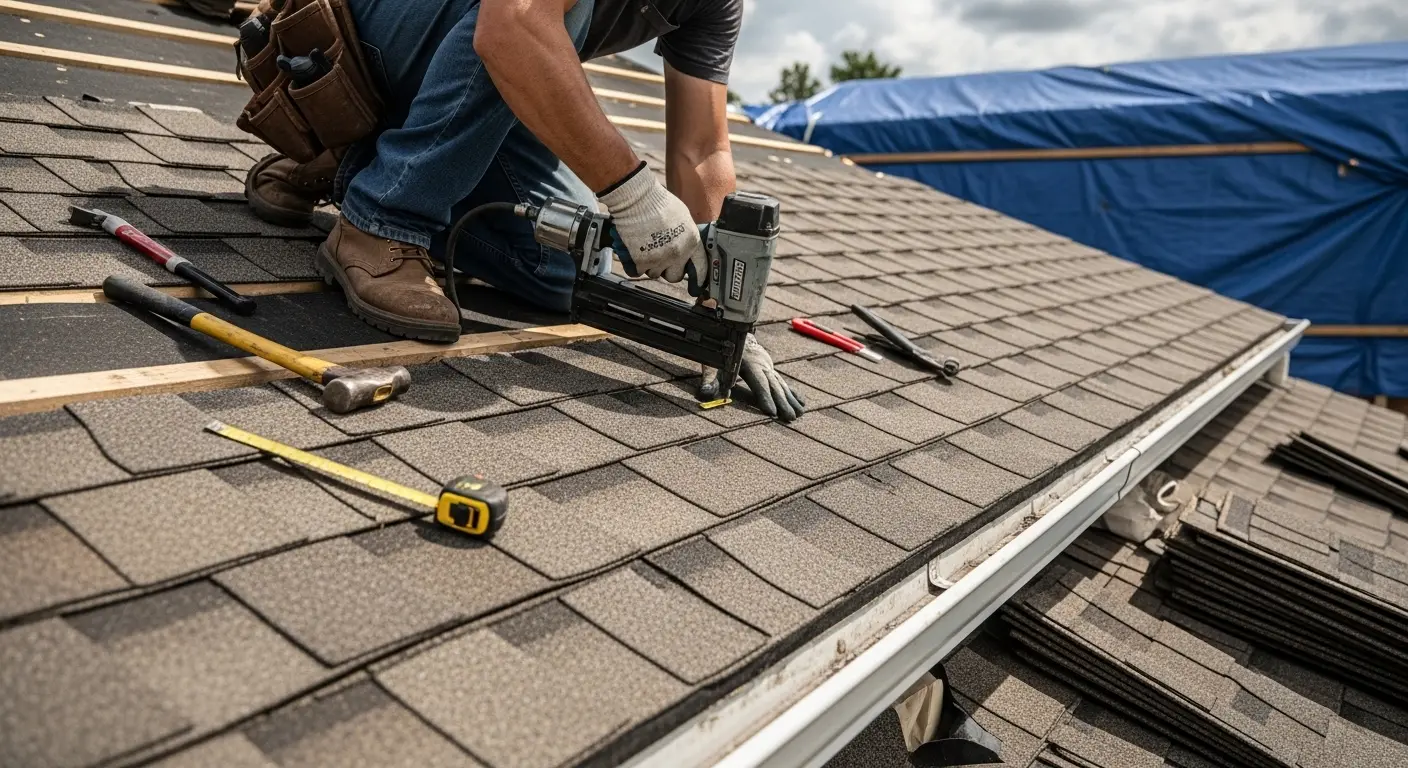
Within days of any named storm, out-of-state crews show up in Hollywood, Fort Lauderdale and Miami with magnetic door signs and a clipboard. Some are legitimate contractors chasing volume. Some hold no Florida license at all. And a few are not really in the roofing business at all, they are in the business of getting your signature on paper and selling it.
The tell is almost always the offer itself. A stranger who has never been on your roof telling you that you definitely have damage, that insurance will cover all of it, and that your deductible will not be a problem, is describing something Florida specifically prohibits.
Under section 489.147 of the Florida Statutes, a contractor may not pay, waive or rebate your insurance deductible, and may not offer you cash, a gift card, a rebate or anything else of value in exchange for inspecting your roof or filing a claim. Advertisements are required to carry a warning saying exactly that. So if someone is offering, they are either breaking the law or lying about their ability to do it, and neither one is who you want walking your roof.
- No Florida license number on the truck, the card or the contract. Every licensed roofing contractor has one, and ours is CCC1337306.
- Pressure to sign today, or a document presented as an inspection authorization that turns into a work order once you sign it.
- Any offer to cover, absorb, discount or take care of your deductible.
- A promise about what your claim will pay before an adjuster has seen anything.
- No local address, and a phone number that stops being answered once the check clears.
Your deductible is your share of the loss, and Florida treats a contractor paying, waiving or rebating it as insurance fraud. An offer to make it disappear is not a discount. It is a reason to close the door.
Repair or replacement, and who you actually need to call
Wind damage is rarely all or nothing. A few blown tabs on one plane is a repair. A whole slope where the seal strips have broken loose is not, because a shingle that has lost its seal looks perfectly normal from the ground and leaks the next time it gusts to 40. How widespread that loss of seal is, how old the roof is, and whether the material can still be matched are usually what decide it.
There is also a code question that surprises people. Section 706.1.1 of the Florida Building Code, Existing Building limits how much of a roof section can be repaired or recovered in any 12-month period before the whole section has to be brought up to current code. Florida Statute 553.844 added an exception: if the existing roof was permitted and built to the 2007 Florida Building Code or later, only the repaired portion has to meet current code. Your permit history can therefore be the difference between a patch and a full roof replacement. Broward and Miami-Dade also sit in the High Velocity Hurricane Zone, where product approvals and fastening requirements are stricter than most of the state.
On the people: a licensed roofing contractor inspects, documents, permits and does the work. A licensed public adjuster works for you on the claim itself and is paid a percentage of what you recover, which Florida caps at 10 percent for claims arising from a declared emergency during the first year and 20 percent otherwise. An attorney is for a denial or a bad faith problem. We are neither of the last two. We will never tell you what your claim is worth, and when your situation genuinely calls for a public adjuster or a lawyer we will say so plainly.
- Licensed roofing contractor: inspects, photographs, writes the scope, pulls the permit, does the work. Ours are CCC1337306 and CBC1266379.
- The carrier adjuster: works for the insurance company, not for you. Be polite, assume nothing.
- Licensed public adjuster: works for you on the claim, paid out of your recovery. Worth considering on a large or contested loss.
- Attorney: for denial, an underpayment you cannot resolve, or bad faith handling.
- Free documented inspection from us: measurement, instant roof report and a written estimate with permits and permit fees included, at no cost and no obligation. Call 954-893-2550.
- If the timing is bad, we offer $0 down financing with no credit check so a deductible and a repair do not have to land in the same month.
Frequently asked
Does homeowners insurance cover a roof leak after a storm?
Generally, sudden accidental damage from wind or a storm is covered and wear, age and deferred maintenance are not. That line is what every adjuster is looking for. Coverage varies by carrier and policy form, and if the National Hurricane Center has issued a hurricane warning for any part of Florida, a hurricane deductible may apply instead of your standard one. Read your declarations page.
Should I tarp the roof myself?
If it is a single-story shingle roof, the weather has fully passed and you are steady on a ladder, a properly battened tarp is reasonable. Otherwise, no. Tile is slippery and cracks under your weight, two stories is a different category of fall, and a tarp that is only weighted down will blow off and take granules with it. More people are hurt after storms than during them.
How long do I have to file a claim in Florida?
Florida Statute 627.70132 currently allows one year from the date of loss to give notice of an initial or reopened property claim, and 18 months for a supplemental claim. Your policy will require prompt notice long before those outside limits, so treat them as a backstop rather than a schedule. Waiting also makes it much harder to tie the damage to a specific storm.
Do I need a permit for a roof repair in Broward or Miami-Dade?
Almost always, yes. Both counties are in the High Velocity Hurricane Zone, where roofing work is permitted and inspected closely and products carry zone-specific approvals. Emergency tarping is generally handled differently from repair work, but the repair itself gets a permit. Requirements and fees differ by municipality. Our written estimates include permits and permit fees in the price.
Should I call a public adjuster or a roofing contractor first?
Call a licensed roofing contractor first and get a documented inspection, because you need to know what is actually wrong before anyone discusses a claim. If the loss is large, the carrier goes quiet, or the offer does not match the damage, a licensed public adjuster is worth considering. We do not adjust claims, and we will tell you when you need someone who does.