

The Roof Replacement Process: What Actually Happens, Day by Day
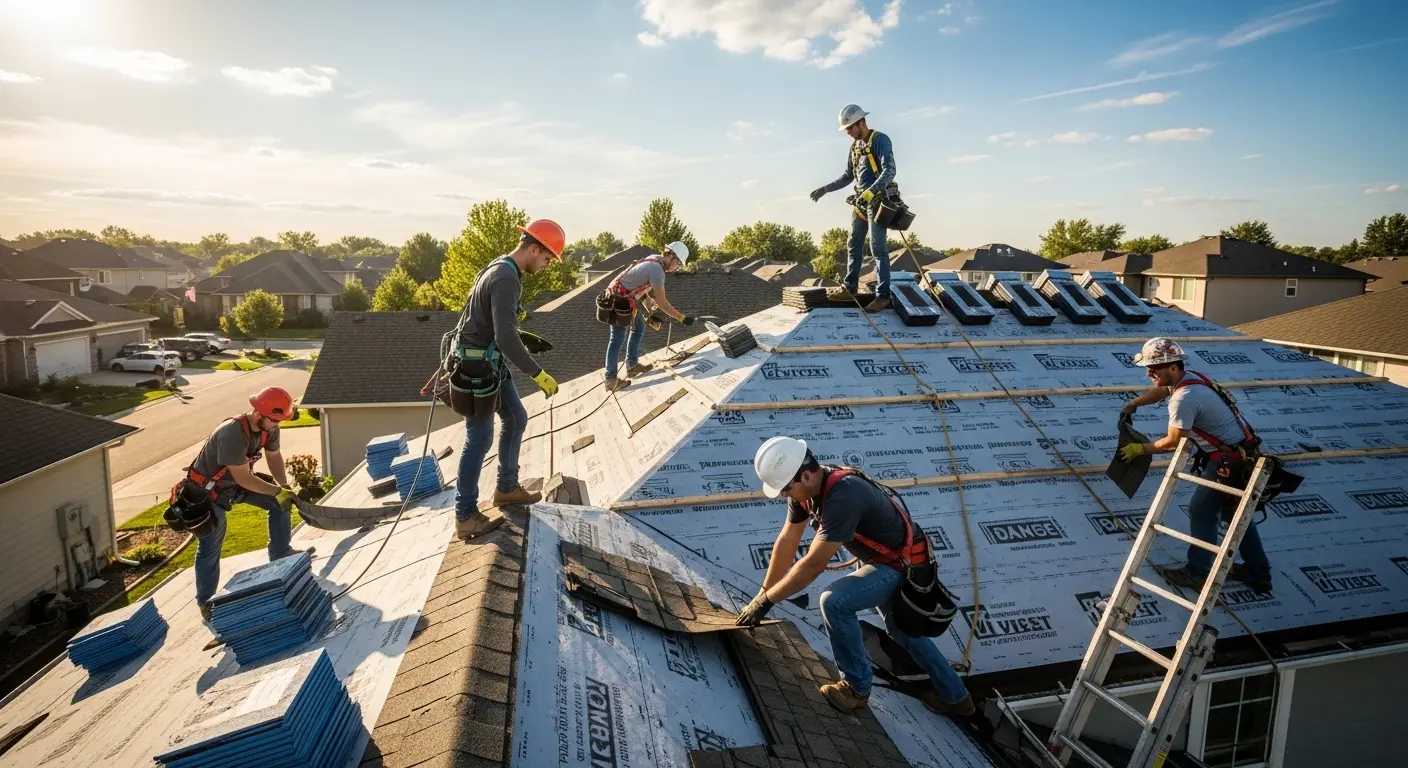
Almost nobody has seen this before. You sign a contract, and a few weeks later a trailer arrives at seven in the morning and men start throwing your roof into it. If nobody has walked you through the sequence, the middle of the job is genuinely unsettling: there is a day when your house has no roof covering on it at all, and another day when the crew does not come because everyone is waiting on an inspector. Both of those are normal, and both of them are much easier to live with if you know they are coming.
A straightforward architectural shingle re-roof on a single-story South Florida house is commonly three to five working days on site. Tile runs longer, often a week to two, because the material is heavier, the loading is slower and there is more hand detail. Add the permit review time before any of that starts, and add weather, because between June and October an afternoon cell can take an hour or a whole day. Any contractor who promises you an exact finish date in July is guessing about the sky.
What follows is the actual sequence we run, in order, with what happens on your side of it. The work you have to do is mostly done before day one: cars, pets, wall hangings, patio furniture and access. After that your job is largely to stay out of the way, keep the driveway clear, and be around at the end for the walkthrough.
The short version
- A shingle re-roof is commonly three to five working days on site; tile commonly runs a week or more
- The roof is never left open overnight; each section is torn off and dried in the same day
- The deck gets sounded and re-nailed to the current fastening schedule while it is exposed
- There is a mandatory in-progress inspection after dry-in, and no covering goes on until it passes
- Take pictures and mirrors off the walls. Tear-off vibration walks things off nails
Before anything happens: measurement, product and permit
It starts with somebody on your roof with a tape and a camera. The on-site measurement produces a plane-by-plane area and an instant roof report, and that is what a written estimate is built from rather than an aerial guess or the county property record. It also settles the questions that decide the schedule: how many layers are coming off, what the ventilation looks like now, where the low-slope sections are, and whether anything about the structure needs an engineer before a roof replacement can be priced at all. If you are still working out whether the roof has reached that point, the honest checklist is in the signs you need a new roof in Florida.
Then you pick the system, and it is a system rather than a color. Covering, underlayment, drip edge and valley metal, fasteners, vents and ridge all have to belong to an assembly with a current Florida Product Approval or Miami-Dade Notice of Acceptance appropriate to your zone, because those approval numbers are part of the permit submittal. Color selection sounds trivial and is worth doing early, since a specific shingle blend or tile profile can carry a lead time. If you are still weighing materials, tile vs metal vs shingle in Florida compares them on service life, weight and salt air, and what a replacement costs here covers what each one does to the number.
Paperwork comes next, and it is the part homeowners underestimate. The contract, the Notice of Commencement that gets recorded and posted at the property, HOA architectural approval if your community requires it, and then the permit application itself with the product approval documents attached. Review time varies by jurisdiction and by how busy the season is, from a few days to a few weeks, and nothing gets scheduled until the permit is issued. We pull the permit under our roofing license, CCC1337306, and the permit and its fees are inside our published pricing. The full sequence, including what happens if a permit is never pulled, is in roof permits and inspections in Broward and Miami-Dade.
- On-site measurement and roof report. Free, no obligation, and the basis for every number that follows. It also flags the surprises before they become change orders.
- System selection, not just color. Covering, underlayment, metal, fasteners and vents all have to carry approvals valid for your zone.
- Notice of Commencement. Recorded and posted at the job site before work begins. Your closing agent and your lender will care about it later.
- HOA approval. Material, profile and color are commonly restricted in deed-restricted communities, and architectural review takes weeks you should build into the schedule.
- Permit issued before scheduling. Anyone offering to start tomorrow on a job permitted the day after is doing it in the wrong order.
The week before: what you have to do
Start inside. Tear-off puts a steady vibration through the whole structure for hours, and anything hanging on a nail will move. Take down pictures, mirrors, wall clocks and anything on a floating shelf, especially on the top floor and on walls that back onto the roof structure. Empty the top shelves of tall cabinets. If your attic is used for storage, either move the boxes out or cover them, because tear-off drops decades of dust and grit through every gap in the sheathing and it goes everywhere. Ceiling fans and light fixtures in the rooms directly under the work are worth a quick look too.
Then the outside. Cars come out of the garage and off the driveway the night before, because the driveway is where material and debris live for the duration and roofing nails end up in places nobody expects. Patio furniture, grills, planters and anything on the pool deck moves away from the house. Point out the sprinkler heads, the septic or well components, the AC condenser and any low-voltage lighting so the crew can work around them. If you have a screen enclosure or pool cage against the eave, say so before the estimate, because protecting it changes how the job is staged. In a gated community or a tight Hollywood street, confirm gate codes and where a trailer is allowed to sit.
Finally, plan your own week honestly. Dogs and cats should be somewhere else on tear-off day; the noise is genuinely distressing for animals and the gate will be open more than usual. If you work from home and take calls, arrange to be elsewhere for the first two days. Tell your neighbors what days to expect noise, and if you share a driveway or a wall, tell them earlier than that. None of this is complicated, but every item on it is something a homeowner has called us about at eight in the morning on day one.
- Wall hangings down. Pictures, mirrors, clocks and anything on a floating shelf, upstairs first. Vibration from tear-off is constant, not occasional.
- Attic storage covered or moved. Old dust and debris fall through the deck as the covering comes off, and it lands on whatever is up there.
- Vehicles out the night before. Driveway and garage apron both. Nails travel further than people expect, and the trailer needs the room.
- Pool deck and patio cleared. Furniture, grills, planters and anything breakable moved well away from the drip line of the roof.
- Pets somewhere else. Especially for tear-off. It is loud, it lasts all day, and gates get opened repeatedly.
- Access sorted in advance. Gate codes, HOA delivery windows, where the trailer parks, and any sprinkler head or utility the crew needs to avoid.
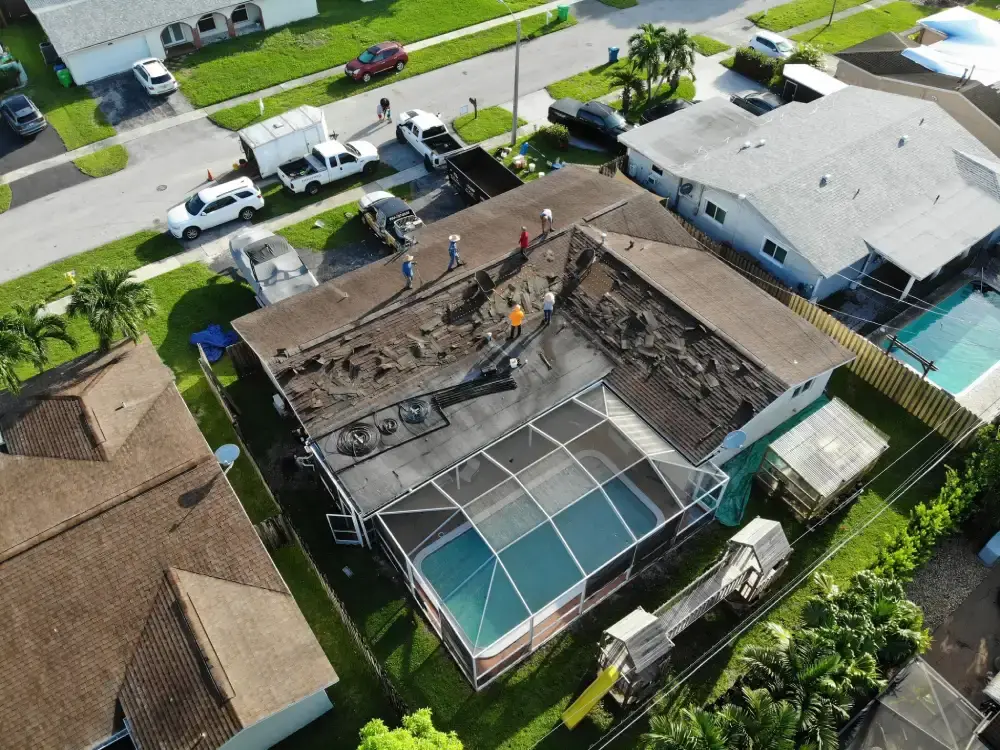
Day one: protection, tear-off and what the deck is hiding
Material and the dump trailer usually arrive first, sometimes the afternoon before. Then the crew spends the first part of the morning protecting things rather than removing anything: plywood or boards over the driveway surface, tarps down the walls and over the landscaping, protection over a pool cage or screen enclosure, and the ground perimeter set up so debris lands where it is supposed to. This part looks slow and is not optional. The difference between a careful crew and a fast one shows up in your hedges and your window screens, not on the roof.
Tear-off is the loud day, and it is worth being honest about what that means. Shovels and pry bars working shingle off decking is a hard, continuous scraping and banging directly over your ceiling, punctuated by loads of debris hitting a steel trailer. It carries through the whole house. Most crews start early to get the heavy work done before the afternoon heat, within whatever hours the local noise ordinance allows, and the first two hours are the worst of it. Tile tear-off is a different sound, heavier and slower, and the loading of new tile back up is its own noisy afternoon. Nothing about it damages the house. It is just genuinely unpleasant to sit under.
Only part of the roof comes off at a time, sized so that whatever gets stripped can be dried in the same day. Your house is not left open overnight. As each section is exposed, the deck gets inspected: every sheet walked and sounded, delaminated or rotted sheathing marked and replaced, and the whole deck re-nailed to the current fastening schedule, which is a requirement on a re-roof here and a credit line on your wind mitigation form later. This is the moment when a job can gain a line item, because nobody knows the bad sheet count until this exact point. Ask to see the sheets that come out before they go in the trailer.
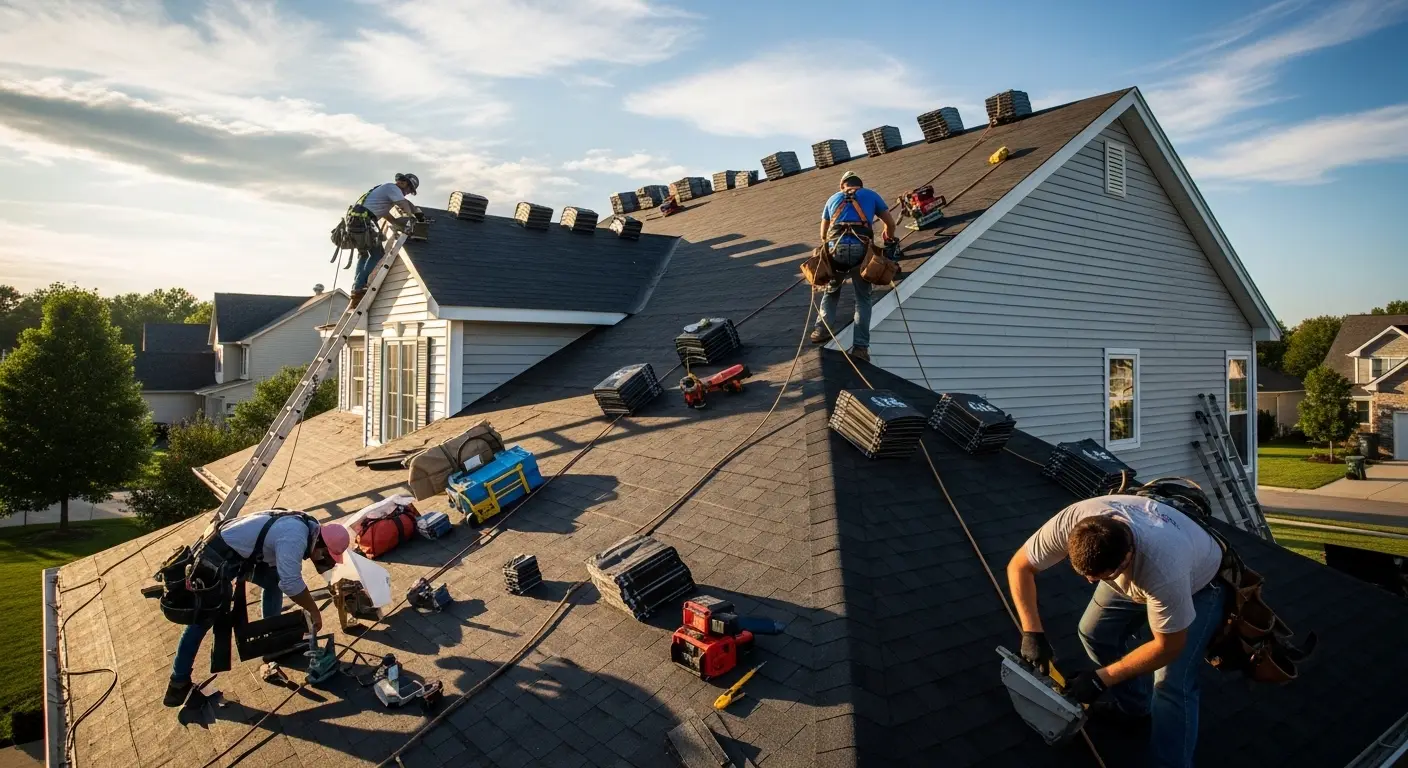
Ask the foreman how much of the roof is coming off today and when it will be dried in. A crew that can answer precisely has planned the sections around the weather and the daylight. That is the single best predictor of how the rest of the week goes.
Dry-in, the in-progress inspection, and the quiet days
Dry-in is the part that actually keeps water out of your house, and it goes down the same day the deck is exposed. On most of what we install that means a self-adhered underlayment bonded directly to the sheathing, which also functions as the secondary water barrier that a wind mitigation inspection looks for and that keeps the house dry if the covering above it is ever torn off in a storm. Perimeter metal and valley metal are set in sequence with the underlayment rather than after it, because the order of those laps is what makes the assembly shed water. At the end of dry-in your roof looks finished and flat and slightly odd, and it is watertight.
Then the crew stops, and this is the day homeowners call to ask if something has gone wrong. Nothing has. There is a mandatory in-progress inspection after dry-in, and no covering can go on until an inspector has been out and passed it. That visit is scheduled with the building department and lands when it lands. It is also the inspection that protects you: an independent set of eyes confirming the fastening and the underlayment before they get buried under tile or shingle forever. What each inspection actually checks, and how to look up the results on your address, is in the permits and inspections post.
After it passes, the covering goes on. Shingle moves fast: starter course, field, hip and ridge caps, with flashing and boots detailed as the crew comes to them. Tile is slower, because it gets loaded onto the roof in stacks first and then set course by course, with hips and rakes cut to fit. Metal panels are cut to length and run from eave to ridge with the seams and closures detailed as they go. This is the visible progress stretch and it is much quieter than tear-off, mostly nail guns and cutting. Everything about replacing a roof that determines whether it survives twenty hurricane seasons is decided in the two stages before this one.
- Dry-in happens the same day as tear-off. Section by section, so the deck is never left exposed to an overnight or an afternoon storm.
- Self-adhered underlayment doubles as the secondary water barrier. It is what keeps the house dry when the covering above it is gone.
- Drip edge and valley metal are sequenced, not added later. The order of the laps is the whole point.
- The in-progress inspection is mandatory. The crew genuinely cannot proceed until it passes, and the timing belongs to the building department.
- Tile gets loaded before it gets set. A noisy afternoon of stacking that looks like nothing is being accomplished. It is.
- Penetrations get rebuilt, not reused. New pipe boots, new vent flanges, new counterflashing where the roof meets a wall or a chimney.

Cleanup, final inspection and the paperwork you keep
Cleanup is not a single event at the end. Debris gets cleared daily, and the final pass includes a magnet sweep of the driveway, the walkways, the lawn and the beds on every side of the house, usually more than once and in different directions, because a magnet only picks up what it passes over. Gutters get cleared of tear-off debris and granules, since a re-roof drops a remarkable amount of grit into them, and this is the natural moment to replace them if they were already tired. If your gutters are going to be replaced anyway, doing it now saves handling the same fascia twice.
Then the final inspection. The building department comes back out, reviews the completed installation and closes the permit, and that closed permit is the document that matters for the next fifteen years. It is what an insurance underwriter dates your roof from, what a buyer asks for, and what a title company looks for at closing. Get the permit number, the inspection results and the closeout in your own files rather than assuming your contractor will still be reachable in a decade. Once the work is closed out, order an updated wind mitigation inspection: a new roof commonly improves the deck attachment, covering and secondary water resistance lines on the form all at once, and the credits are only applied if you send the form to your agent. The context for that is in Florida homeowners insurance roof requirements.
Last comes the walkthrough. Go around the house with the foreman, look at the perimeter from the ground on all four sides, check the driveway and the beds for nails, and look at anything that was protected. Ask for the photographs of the deck and the dry-in, because you will never see those layers again. Then the warranty documents: the manufacturer coverage on the material and the separate workmanship warranty on the installation, which are two different things with two different terms. If financing is part of how you paid for this, the terms live on our financing page, and anything you are unsure about on the closeout package is worth a call to 954-893-2550 or a message through our contact page. You can see the whole scope of our roof replacement service in one place.
- Magnet sweep, more than once. Driveway, walkways, lawn and beds, in more than one direction. Ask for it again a week later if you keep finding nails.
- Gutters cleared of granules and debris. A re-roof fills them. If they were already failing, replacing them now avoids paying for the same access twice.
- Closed permit in your file. Permit number, inspection results and final closeout. It is what your insurer, your buyer and your title company will ask for.
- Photographs of the deck and dry-in. The layers you are never going to see again are the ones worth having documented.
- Both warranties in writing. Manufacturer coverage on the material and workmanship coverage on the installation, with the terms and the transfer rules of each.
- Updated wind mitigation inspection. Order it after the permit closes, then send the form to your agent yourself. Nobody does it for you.
Frequently asked
How long does a roof replacement take?
A straightforward architectural shingle roof on a single-story South Florida house is commonly three to five working days on site. Tile usually runs a week or more because the material is heavier and there is more hand detail. Add permit review before the start, which can be days or weeks depending on the jurisdiction, and add rain delays during the wet season. The in-progress inspection can also add a day of waiting.
Do I need to be home during the work?
No, and most homeowners are not. The crew works entirely outside and does not need access to the interior. You do need to be reachable by phone in case something is found on the deck, and it is worth being there on the last day for the walkthrough. If you work from home and take calls, plan to be somewhere else for tear-off day, which is genuinely loud.
Will my house be exposed if it rains?
It should not be. Tear-off is done in sections sized so that everything opened up gets dried in the same day, and the roof is not left uncovered overnight. Once the self-adhered underlayment is down the deck is watertight even before the covering goes on. Afternoon storms in the wet season can pause work for an hour or a day, which is the main reason a schedule moves.
What happens if the crew finds rotten decking?
It gets replaced, sheet by sheet, before anything goes over it. The count cannot be known until the old covering is off, which is why decking is priced per sheet in the contract rather than guessed at up front. Ask to see the sheets that come out before they go in the trailer, and ask for photographs. On a roof with long-running leaks around penetrations, expect more of them.
How messy is a roof replacement?
Messier than you expect and cleaner than you fear. Tear-off drops dust and grit through the deck into the attic, and debris and nails end up around the perimeter of the house. Good crews protect the driveway, walls and landscaping before anything comes off, clear debris daily, and run a magnet sweep at the end. Cover attic storage in advance and keep vehicles off the driveway.