

Roof Permits and Inspections in Broward and Miami-Dade
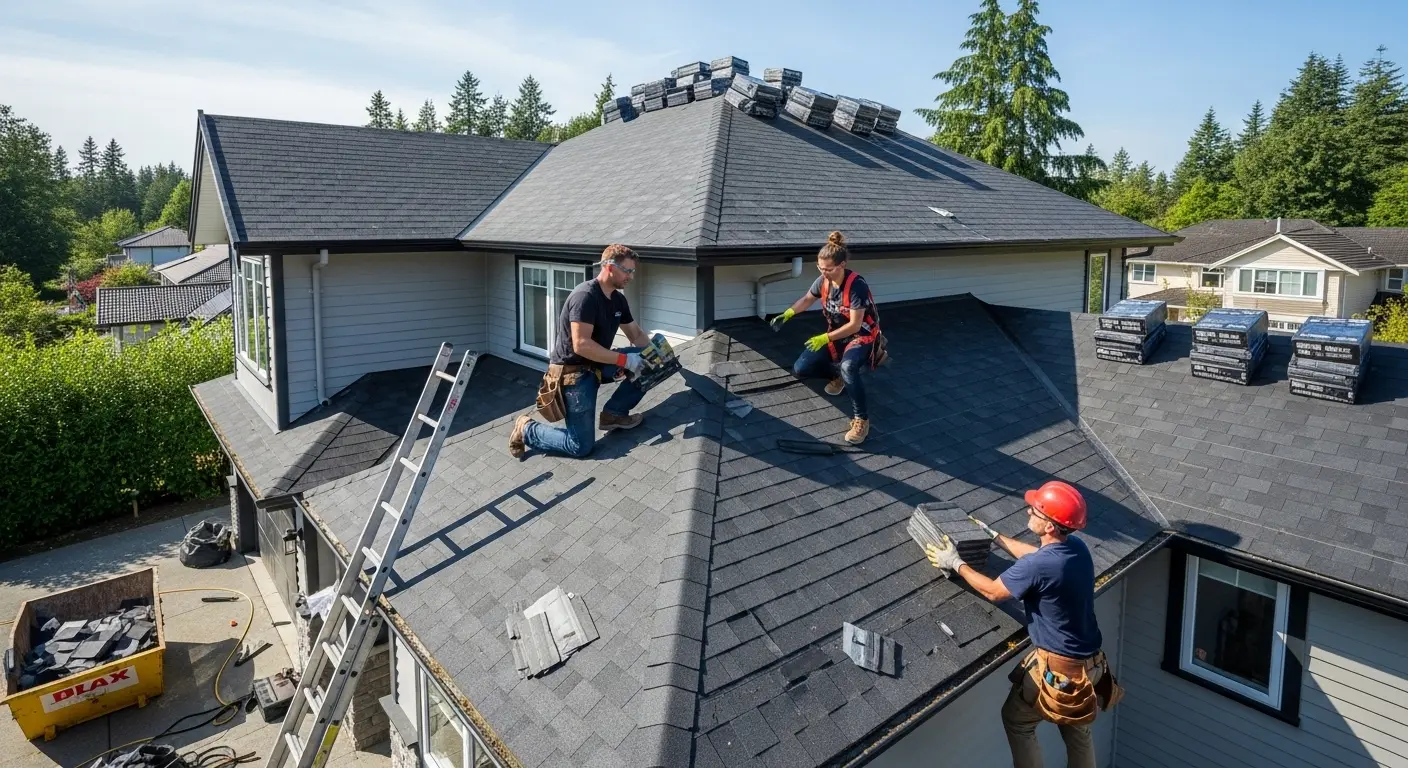
Every so often a homeowner asks whether the job can be done without a permit, because somebody quoted it that way and the number was better. The answer is no, and the reasons have very little to do with rules for their own sake. The permit is the only point in the entire project where a person with no financial stake in it climbs up and looks at your roof before it gets covered over. Take that away and the only assurance you have that the deck was re-nailed correctly and the underlayment was installed to its approval is the word of the person you are paying.
Broward and Miami-Dade sit inside the High Velocity Hurricane Zone, which is the strictest wind design region in the country. That shows up in the permit as a specific requirement: the products going on your house have to carry approvals valid for that zone, and the approval numbers are part of what gets submitted. Palm Beach sits outside the HVHZ and still designs to high wind loads with its own requirements. In all three counties the sequence is broadly the same, though every city runs its own building department with its own fees, forms and review times.
This post covers who is allowed to pull the permit and what it costs, what goes into the submittal, the order the inspections happen in, what an unpermitted roof does to a home sale and an insurance claim, and how to look up your own address and confirm that a permit was pulled and actually closed.
The short version
- The permit is pulled under the roofing contractor license, not by the homeowner, and our license number is CCC1337306
- HVHZ product approval or Notice of Acceptance paperwork for the covering, underlayment and fasteners is part of the submittal
- There is an in-progress inspection after dry-in and a final inspection at the end, and no covering goes on until the first one passes
- Our published pricing includes the permit and the permit fees rather than adding them at the end
- You can look up any address on the city or county building department portal and see whether the permit was finaled
Who pulls the permit, and why it should never be you
A roof permit is pulled by a state-certified or registered contractor under their own license, and it makes that contractor responsible to the building department for the work. When a contractor asks the homeowner to pull the permit instead, usually described as saving money or saving time, what is actually being transferred is liability. Florida allows an owner-builder to permit work on their own homestead in limited circumstances, and the form you sign says in plain language that you are taking on the responsibilities of a licensed contractor for that job. If the work fails inspection or fails in a storm, the person on the hook is the person on the permit.
There is a second reason, which is that a contractor who asks you to do it may not hold the license required to do it themselves. That is the single most useful screening question in this trade. Ask for the license number, ask whether the permit will be pulled under it, and then verify the number rather than admiring it on a business card. For roof replacement work in Florida the relevant credential is a roofing contractor license; ours is CCC1337306, alongside CBC1266379 on the building side.
The cost is smaller than most people assume and it is usually scaled to the value of the job, which means it varies by city and by the size of your roof rather than sitting at one published figure. On a typical single-family re-roof in Broward or Miami-Dade it is commonly a few hundred dollars, plus separate charges for things like recording documents or additional inspections. Our published per-square-foot pricing has the permit and the permit fees inside it, which matters when you are comparing two written estimates, because a bid that leaves them out looks cheaper until it is not. That comparison, and everything else that moves the number, is in what a roof replacement costs in South Florida.
- The contractor pulls it, under their license. That is what makes them answerable to the building department for the installation.
- An owner-builder permit shifts responsibility to you. Read what you are signing. It is not a formality and it is not a discount.
- Being asked to pull it yourself is a screening question. Frequently it means the person doing the work cannot pull it.
- Verify the license number. A number on a truck door is not verification. State license records are public and searchable.
- Confirm permit fees are inside the price. Ours are. Not every estimate you collect will be, and the gap is usually several hundred dollars.
What goes into the submittal, including the NOA paperwork
A roofing permit application is not one page. It carries the scope of work, the roof area, the existing and proposed coverings, the design wind speed and exposure category for your address, and the product documentation for what is going on the house. That last piece is the part specific to South Florida. Every component of the assembly has to carry a current Florida Product Approval or, inside the High Velocity Hurricane Zone, a Miami-Dade Notice of Acceptance. Not just the shingle or the tile: the underlayment, the fasteners, the ridge and hip system and the vents all have approvals, and the approval documents specify the fastening pattern the installation has to follow.
That is the mechanism behind a detail worth understanding. The approval is what makes the manufacturer wind rating meaningful, because it ties the rating to a specific installation method rather than to the product sitting in a box. A shingle rated for high wind that is fastened with four nails where the approval calls for six is not a high wind roof, it is a shingle. The inspector checks against the approval, which is precisely why the documents go in with the application. Every replacement roof we install is submitted this way, and you are entitled to a copy of the approval documents for what went on your house.
Two other items travel with the application. A Notice of Commencement gets recorded with the county and posted at the property before work starts on jobs above a dollar threshold that every roof replacement clears; it is what protects you in the lien process and what a closing agent will look for later. And if you live in a deed-restricted community or a condominium, the association approval is a separate track that can take longer than the building department, so start it early. Review times vary widely by jurisdiction and by season, from a few days to a few weeks, and a job in Broward County can move on a different clock than an identical job one city over.
- Product approval or NOA for every component. Covering, underlayment, fasteners, ridge system and vents, each with its own approval and its own required fastening pattern.
- Design wind speed and exposure category. Address-specific. It is what the fastening schedule is derived from.
- Scope and measured roof area. The same measurement that produced your estimate, which is one reason an accurate measurement matters twice.
- Notice of Commencement. Recorded with the county and posted at the site before work begins. Keep the recorded copy.
- HOA or condo association approval. A separate approval on a separate timeline, commonly covering material, profile and color.
- Revisions happen. A plans examiner can come back with comments, and that is a normal part of review rather than a sign anything is wrong.
The inspection sequence, and what each one is looking at
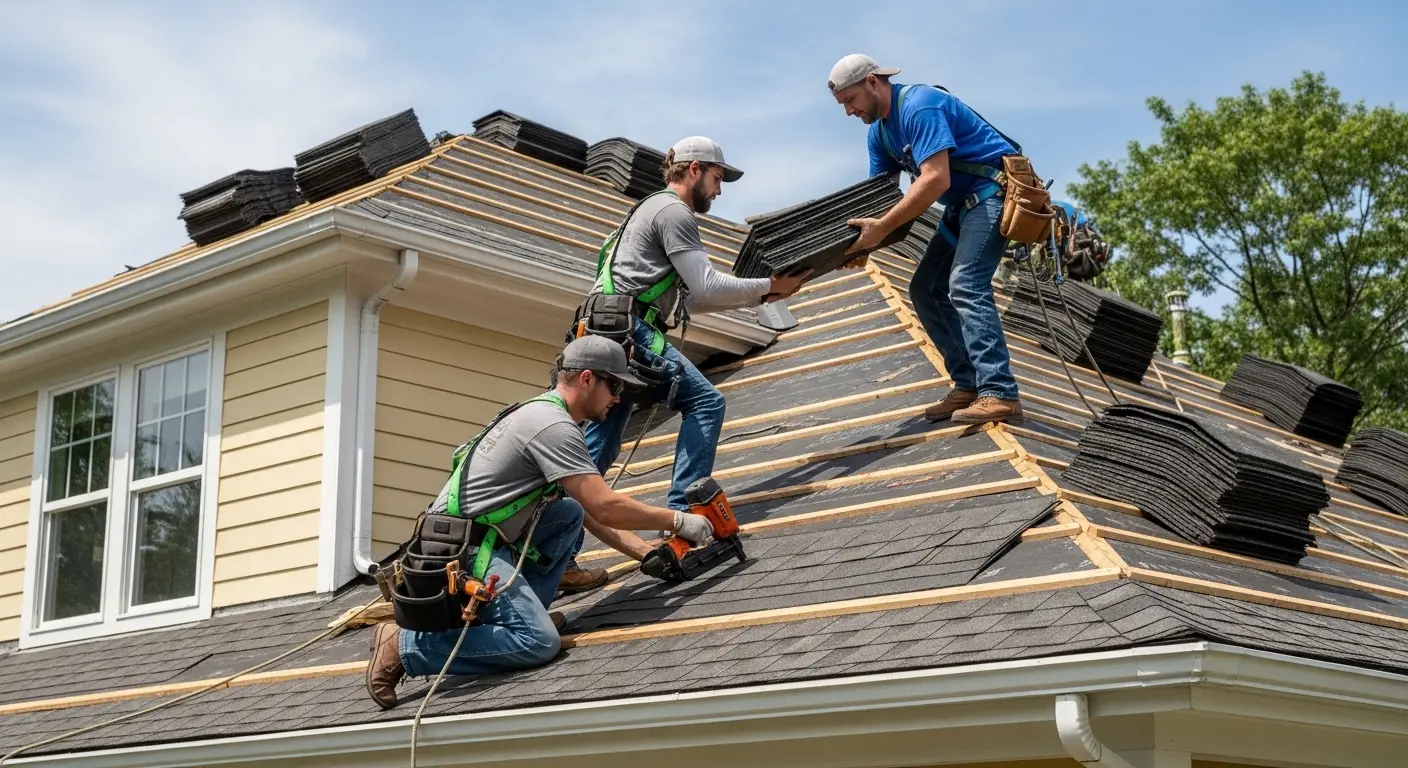
The first inspection happens in the middle of the job, not at the end, and it is the one that does the real work. Once the old covering is off, the deck has been re-nailed to the current fastening schedule and the underlayment is down, an inspector comes out to look at the dry-in before anything covers it. In practice this is often bundled with the sheathing and re-nail check, and jurisdictions describe it slightly differently, but the function is identical: verify the fastening and the water barrier while they are still visible. Once tile or shingle is over the top, nobody can confirm any of it without taking the roof apart again.
This is why your crew stops for a day. They are not allowed to proceed until the in-progress inspection passes, the appointment belongs to the building department rather than to the contractor, and it lands when it lands. If you want the day-by-day view of where this falls in the job, it is laid out in the roof replacement process step by step. A failed inspection is not a catastrophe either; the correction gets made and a re-inspection gets scheduled, usually with a fee attached, and the delay is measured in days.
The final inspection comes after the covering, the flashings, the ridge and the penetrations are complete. The inspector reviews the finished installation and, when it passes, the permit is finaled and closed. That closed permit is the durable output of this whole exercise. It is the date an insurance underwriter uses for the age of your roof, the document a buyer asks for, and the record that makes the wind mitigation credits provable. A roof without one is, in every system that matters, a roof that does not exist.
- In-progress or dry-in inspection. Deck fastening and underlayment verified before any covering goes over them. The most important inspection on the job.
- Sheathing and re-nail check. Frequently part of the same visit. Confirms the deck was refastened to the current schedule while it was exposed.
- Work stops until it passes. The pause is the system working. Scheduling belongs to the building department, not to your contractor.
- Failed inspections get corrected and re-inspected. Expect a re-inspection fee and a few days, not a rebuilt roof.
- Final inspection closes the permit. Covering, flashings, ridge and penetrations reviewed as a finished system.
- Keep the results. Permit number, inspection history and the final. You will be asked for them at a sale, a claim or a renewal.
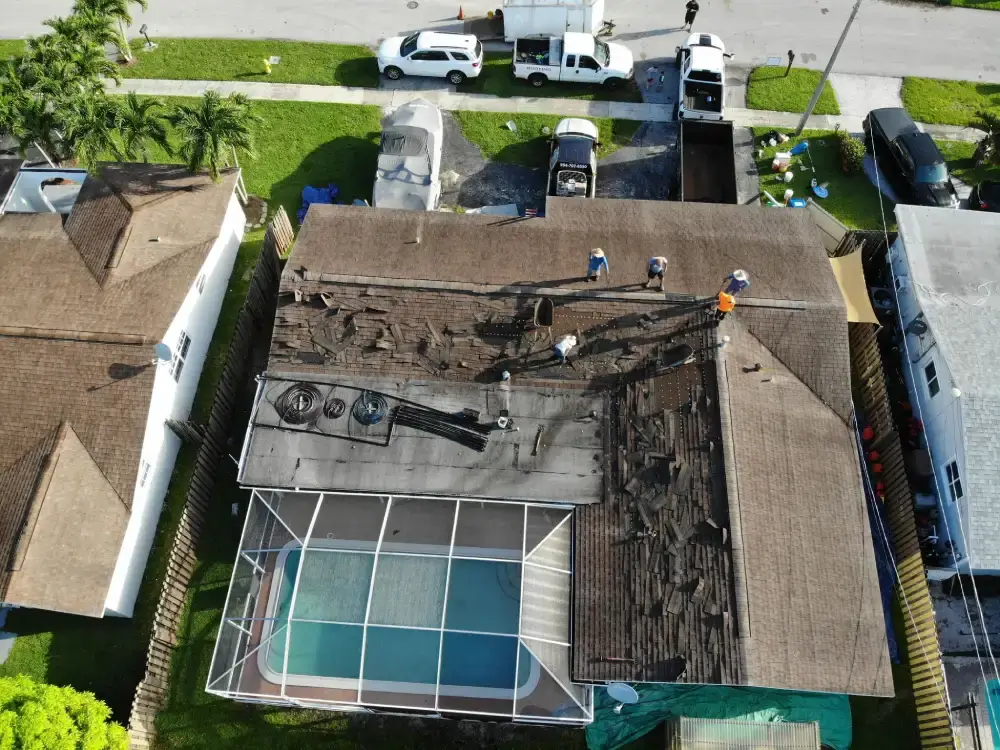
A building inspector has no financial interest in your job. They are checking the installation against the product approval and the code, which is exactly the check a homeowner cannot perform. Every dollar saved by skipping a permit is a dollar saved by removing the only neutral party from the transaction.
What an unpermitted roof costs you later
It surfaces first at a sale. Title and closing work turns up permit history, and a roof with no permit, or a permit that was pulled and never finaled, becomes a condition of closing. The seller ends up applying for an after-the-fact permit, which jurisdictions commonly charge at a multiple of the normal fee, and the building department may require portions of the work to be opened up so it can be inspected retroactively. That is a negotiation happening under a contract deadline with a buyer who now has a reason to ask for a credit. An open permit from a previous owner does the same thing and is depressingly common.
It surfaces again at the insurance company. Carriers date your roof from the permit record, so an unpermitted replacement does not reset the roof age in their file no matter how new the material is; you paid for a new roof and get underwritten on the old one. The wind mitigation form also asks for the permit application date and the roof covering approval, and an inspector who cannot document them cannot give you the credits. On a claim, no permit history means the carrier can ask hard questions about when and how the work was done, and the burden of answering is yours. The wider picture is in Florida homeowners insurance roof requirements, and permit history comes up early after a storm too, as we covered in what to do about a roof leak after a storm.
It also matters for smaller work than a full re-roof. Most jurisdictions require a permit for roof repair above a modest scope, and current Florida Building Code generally requires that when more than about a quarter of a roof section is repaired or replaced within a twelve-month period, that section be brought up to current requirements rather than patched to the old standard, with limited exemptions. That single rule quietly turns a lot of large repairs into replacements, and it is one of the variables in deciding whether to repair or replace. If you are being quoted a large repair with no permit mentioned anywhere, ask why. Doing it correctly in Miami-Dade County and doing it cheaply are not the same project, and replacing a roof without a record is a discount you pay back later with interest.
- At closing: an unpermitted or unfinaled roof becomes a condition of sale, on the buyer timeline, with after-the-fact fees attached.
- At renewal: carriers date the roof from the permit. No permit, no reset, regardless of what is actually on the house.
- On the wind mitigation form: the permit application date and covering approval are line items. Missing paperwork means missing credits.
- At a claim: no permit history means no independent record of when the roof was built or how, and the burden of proof is yours.
- On repairs too: repair work commonly needs a permit, and exceeding roughly a quarter of a roof section in a year generally triggers current-code requirements for that section.
- On the warranty: manufacturer system coverage assumes a compliant installation. Unpermitted work is a bad position to argue from.
How to check the permit on your own address
You do not need permission from anyone to do this and it takes about ten minutes. Every city and county building department in South Florida runs a public online portal where you can search permits by property address. Search yours and read the whole history, not just the most recent entry. You are looking for a roofing permit with a date that matches when the work was done, the contractor and license shown as the permit holder, an inspection history with results, and a status that says the permit was finaled or closed. If your city contracts out its building services, the search may live on a county site or a third-party portal, and the department will tell you which if you call.
Three findings are worth acting on. A permit that exists but was never finaled means an inspection was missed or failed and nobody came back; that can usually be resolved by getting the remaining inspections completed, though it gets harder as years pass. No permit at all for a roof you know was replaced means the work was never inspected by anybody, and you should treat the roof as an unknown quantity. And a permit still open from a previous owner is the one to deal with now rather than the week you list the house.
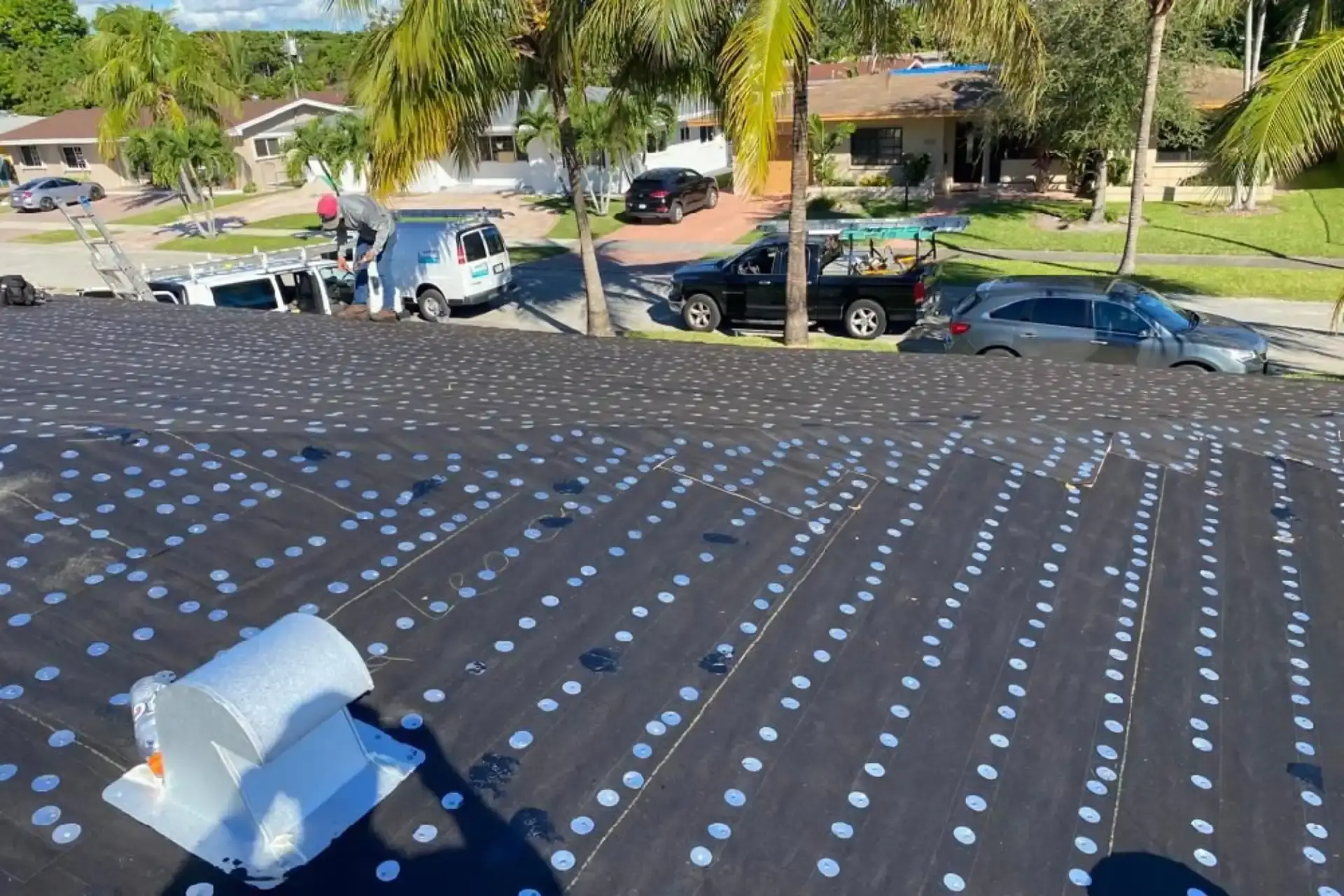
While the work is happening, the simpler check is the permit card. It gets posted at the property, it carries the permit number, and inspection results get recorded against it. Ask for the permit number on day one and keep it. At the end, ask for the closeout package: the finaled permit, the product approval documents for what went on your roof, the manufacturer warranty and the workmanship warranty. If any of that is missing, ask before the final payment rather than after it. We include all of it as a matter of course, and you can see the full scope of our roof replacement page or call 954-893-2550 with a permit question even if we did not do the work. Free inspection, free measurement, written estimate, and you can start that from our contact page.
- Search the building department portal by address. Every jurisdiction here has one, and permit records are public.
- Check the status, not just the existence. Issued is not closed. You are looking for finaled or closed with a complete inspection history.
- Match the permit holder to your contractor. The license on the permit should be the license of the company doing the work.
- Ask for the permit number on day one. It should also be on the card posted at the property while the job runs.
- Deal with an old open permit now. It is a routine problem in a quiet month and a leverage point during a closing.
- Collect the closeout package. Finaled permit, product approvals, manufacturer warranty and workmanship warranty, before the final payment clears.
Frequently asked
Do I need a permit to replace my roof in Florida?
Yes. Roof replacement requires a permit everywhere in Broward, Miami-Dade and Palm Beach, and most roof repairs above a small scope do as well. The permit is pulled by the licensed roofing contractor under their license, and it triggers the inspections that verify the deck fastening and the underlayment before they are covered. Work done without one is not inspected, not recorded, and not treated as a new roof by your insurer.
How much does a roof permit cost in Broward or Miami-Dade?
It varies by city and is usually scaled to the value of the job, so there is no single published figure. On a typical single-family re-roof it commonly runs a few hundred dollars, with separate charges for recording and for any re-inspections. Our published per-square-foot pricing includes the permit and the permit fees, so ask any other contractor directly whether theirs does before comparing the two totals.
How long does it take to get a roof permit?
Anywhere from a few days to a few weeks depending on the jurisdiction and the season, and it is the least predictable part of the schedule. Volume spikes after a storm, and a plans examiner can return comments that need a revision before issuance. HOA architectural approval, where it applies, runs on its own separate timeline and is frequently the slower of the two, so start it as early as you can.
What is an NOA and why does my roof need one?
A Notice of Acceptance is Miami-Dade product approval documentation showing that a specific product has been tested and accepted for use in the High Velocity Hurricane Zone. Inside the HVHZ the covering, underlayment, fasteners and vents each need current approval, and the approval also prescribes how the product must be fastened. It goes in with the permit application, and the inspector checks the installation against it.
What do I do if I find an open roof permit on my house?
Call the building department that issued it and ask what remains outstanding. Usually it is a missed final inspection, and the fix is scheduling the remaining inspections, sometimes with the original contractor and sometimes with a new one who will assume the permit. Handle it now rather than during a closing, because an open permit under a contract deadline turns into a price negotiation you will lose.