
Standing Seam or Exposed Fastener: the Decision That Shapes the Whole Roof
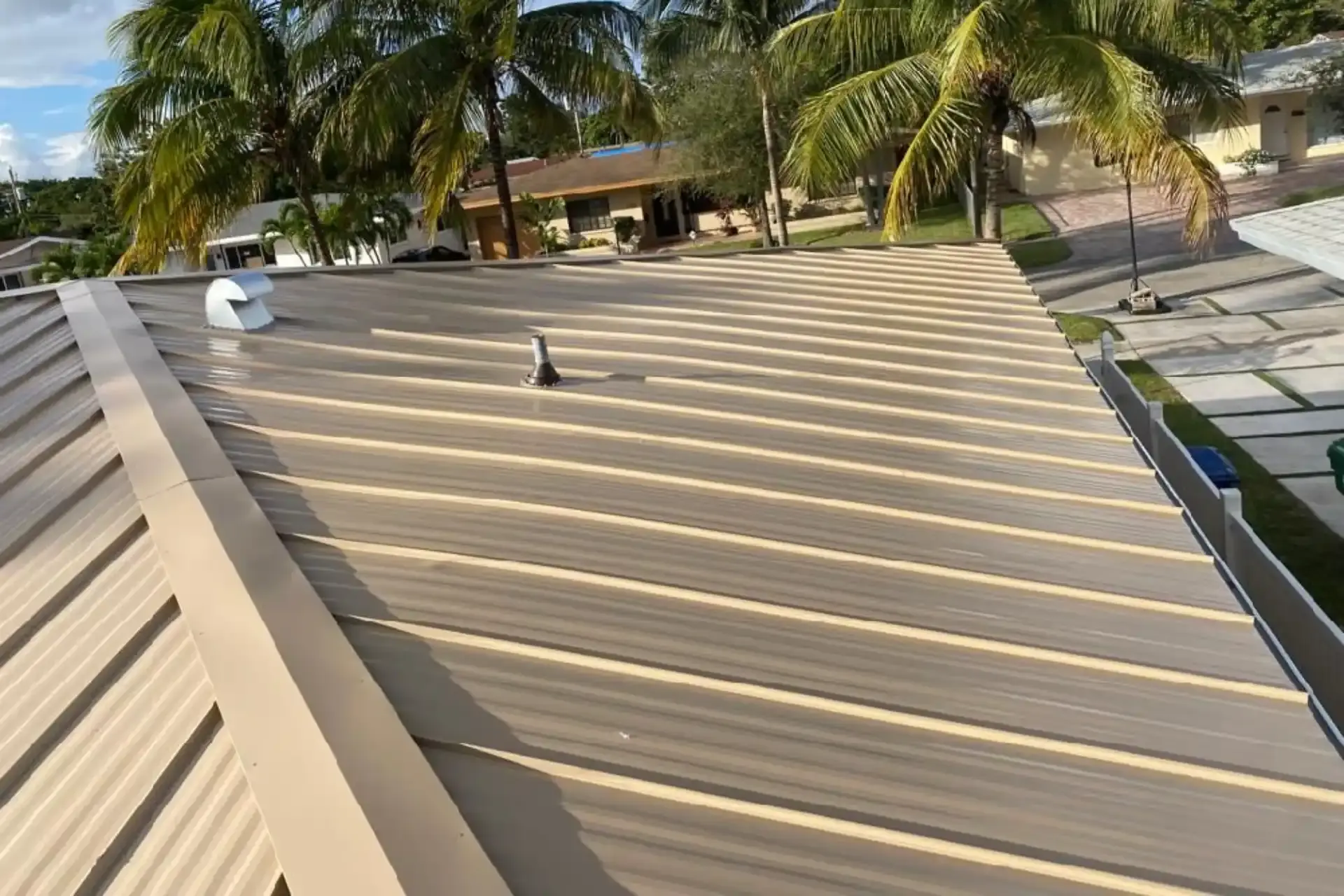
Once you have decided on metal, there is one more decision left and it matters more than the color, the brand or the warranty booklet. It is whether the fasteners holding your roof down sit hidden inside the seam between panels, or pass straight through the face of the panel with a rubber washer under the head. Everything else about how the roof behaves follows from that one detail: how it handles the daily expansion and contraction, where water can eventually find a way in, how flat it looks in afternoon light, and what somebody will have to do to it in year fifteen.
Homeowners are usually presented with this as a price ladder, with standing seam at the top and exposed-fastener panels at the bottom, and that framing hides the actual engineering. Both systems are legitimate. Both are installed by the thousand across Broward, Miami-Dade and Palm Beach. One asks for more money now and almost nothing later. The other asks for less money now and a genuine maintenance obligation later. Neither answer is wrong, and a contractor who declares one of them universally correct is telling you about their preferred scope of work rather than about your house.
What follows is the mechanical explanation, without the sales framing. How each system attaches, how each one deals with metal that grows and shrinks every day of its life, what the neoprene washer really is and when it needs attention, the difference between a snap-lock seam and a mechanically folded one, where 5V crimp legitimately belongs, and what gauge and panel width do to appearance. The money side of these choices lives in the cost post in this series so it does not get repeated here.
The short version
- Standing seam conceals its clips inside the seam; exposed-fastener panels are screwed through the panel face
- Metal grows and shrinks every day, and a floating clip lets a panel move while a face screw pins it in place
- The neoprene washer under an exposed screw is the wear item, commonly needing attention around 10 to 20 years
- Snap-lock seams close under hand pressure; mechanically seamed panels are folded shut with a seaming machine
- 5V crimp is an exposed-fastener system and a legitimate roof, particularly on porches, additions and older cottages
Where the fasteners live is the entire difference
On a standing seam roof, the panel is held down by clips. A clip is a small formed piece of metal screwed to the deck, sitting inside the vertical seam where two panels meet, gripped by the seam when the next panel is locked over it. The screws never pass through the water-shedding surface. When the roof is finished, the only fasteners visible anywhere are at trim and flashing details, and even those are minimized by hemmed edges and cleats. That is the whole design intent: nothing on the panel face for wind to work on and no hole through the plane that is supposed to keep the rain out.
On an exposed-fastener roof, the panel is screwed directly through its face into the deck or into a purlin, and each screw carries a bonded washer with a neoprene sealing ring under the head. The screw provides the holding power and the washer provides the seal. It is simple, fast and thoroughly proven, and it has one structural consequence you should understand clearly: every screw is a deliberate hole through the waterproofing, kept dry by a compressed piece of rubber. There are commonly a few thousand of them on an average South Florida house, and each one is doing that job independently.
That is the honest way to describe the fork. Not good against bad, but no penetrations against several thousand small managed ones. It is the reason the two systems in the metal roof systems we install carry different price tags, different service lives and different obligations, and it is why the choice deserves ten minutes of your attention rather than a glance at the bottom line. What each one costs on your particular roof is broken out in what moves a metal roof price.
- Concealed clip. A formed metal clip screwed to the deck and captured inside the seam. The fastener is inside the assembly rather than out in the weather.
- Face screw with bonded washer. A self-drilling screw with a metal cap and a bonded neoprene ring, torqued to compress the ring without crushing it.
- Screw count. An exposed-fastener roof on an ordinary house commonly carries a few thousand fasteners. Each one is a seal with its own life span.
- Where the screw lands matters. Some profiles are fastened through the flat next to the rib, others through the rib crown. The manufacturer specifies which, and it is not a matter of crew preference.
- Trim fasteners exist on both. Even a standing seam roof has fasteners at the eave, rake and ridge details, which is why the trim design deserves the same scrutiny as the panel.
- Nothing exposed ages slower. The practical reason standing seam commonly reaches 40 years and beyond is that there is no rubber component out in the ultraviolet holding water back.
Thermal movement, and why a pinned panel works against itself
Metal expands when it heats and contracts when it cools, every day, for the life of the roof. In South Florida the surface of a roof panel can swing well over a hundred degrees between a cool morning and a July afternoon, and a long panel run turns that into visible movement. Aluminum moves roughly twice as much as steel for the same temperature change. On a 30 foot run that works out to something on the order of a quarter to half an inch of travel, back and forth, thousands of times over the decades. That movement is not a defect. Every metal roof does it, and the difference between the systems is what happens to it.
Standing seam is designed around it. On longer runs the clips are two-piece floating clips: the base stays fastened to the deck while the top slides, so the panel is anchored at one point, usually near the ridge or the eave depending on the design, and free to grow and shrink everywhere else. On an exposed-fastener roof the panel is pinned to the deck at every screw, so the metal cannot travel. The stress goes somewhere else instead, which over years means slight elongation of the screw holes, fasteners that slowly loosen, and washers that get worked rather than left alone. It is a slower, quieter process than it sounds, and it is precisely why those fasteners have a service interval.
The same movement produces the cosmetic issue people notice on a metal roof before anything else: oil canning, the faint waviness visible in the flat of a panel under raking light. It comes from stresses in the coil, from a deck that is not perfectly flat, from over-tightened fasteners and from the metal simply doing what metal does. It is not a structural fault and no manufacturer warrants against it. What reduces it is a heavier gauge, a narrower panel and striations, which are shallow pencil lines rolled into the panel flat to break up the reflection. If a flawless mirror finish is your expectation, metal is the wrong material.
- Floating clips. Two-piece clips that let the panel slide as it expands. Standard on longer runs and specified by the manufacturer, not chosen on site.
- Fixed points. Every standing seam roof is anchored somewhere so movement runs in a known direction. Where that point sits is part of the system design.
- Panel length limits. Manufacturers publish maximum run lengths for a given profile and clip type. Long runs on a two-story roof are exactly where this gets checked.
- Oil canning is cosmetic. Visible waviness in the panel flat, present to some degree on every metal roof, and excluded from essentially every warranty.
- Striations and minor ribs. Shallow lines rolled into the flat that break up reflections and hide waviness. Usually available at no extra cost on profiles that offer them.
- Deck flatness carries through. A wavy deck telegraphs into the panel. This is one of several reasons we strip to bare sheathing rather than laying panels over an old roof.
The neoprene washer is the wear item, and it has a schedule
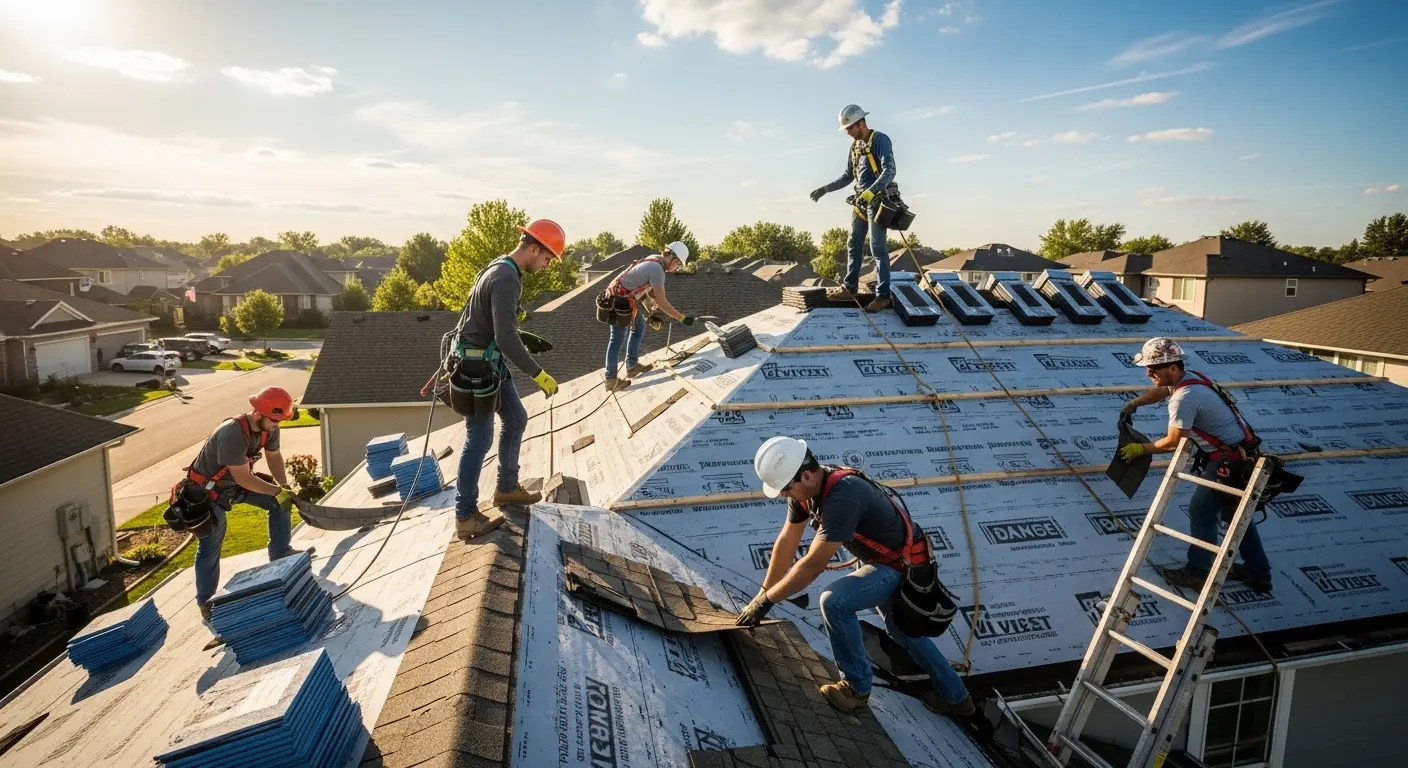
On an exposed-fastener roof the panels will almost certainly outlive the fasteners. Neoprene is a rubber compound and rubber does not enjoy South Florida. Ultraviolet light attacks the exposed edge of the washer, heat cycling takes the elasticity out of it, and constant compression gives it what materials people call compression set, meaning it stops springing back. A washer that has gone hard and cracked no longer seals when the panel moves. Water does not pour in through a failed washer; it wicks in slowly, wets the deck around the screw, and shows up years later as a soft spot in the sheathing rather than a drip on your ceiling.
The realistic interval before an exposed-fastener roof needs its fasteners looked at is commonly somewhere in the range of 10 to 20 years, and on a hot, unshaded southern or western plane it is closer to the front of that range than the back. Looked at does not automatically mean replaced. A crew walks the roof, checks for backed-out screws, cracked or extruded washers and any fastener sitting at the wrong angle, and replaces what has failed. When a screw hole has elongated, the fix is a larger-diameter replacement screw that bites fresh material rather than the same screw driven back into a worn hole, which is why the repair is done properly with a box of oversize fasteners on the roof.
Two installation errors decide how well that goes. Over-driving crushes the washer and squeezes it out from under the cap, which destroys the seal on day one and is visible from the ground as a ring of extruded rubber. Under-driving leaves the washer uncompressed and the seal incomplete. Both are common on fast work, and both show up as leaks long before the material would have failed on its own. If your roof is already at the point where you are counting failed screws rather than finding them, the framework for deciding what to do next is in repair or replace.
- What fails. The neoprene washer, not the screw and not the panel. Ultraviolet, heat cycling and compression set take it out of service.
- When to look. Commonly 10 to 20 years, sooner on hot unshaded planes. A walk-over inspection, not an automatic re-screw of the whole roof, and it belongs on the same visit as any other roof maintenance.
- Backed-out screws. Visible from the ground with binoculars as raised heads or shiny rings. They are the earliest warning and the cheapest moment to act.
- Oversize replacements. A worn hole gets a larger-diameter screw, not the original size driven back in. Ask that the fix be done that way.
- Over-driving is an installation defect. Extruded rubber around the cap means the seal was crushed at installation, and it will leak regardless of the material quality.
- Budget for it honestly. The lower price of an exposed-fastener system comes with this obligation attached. Priced across the life of the roof it is still frequently the better buy.
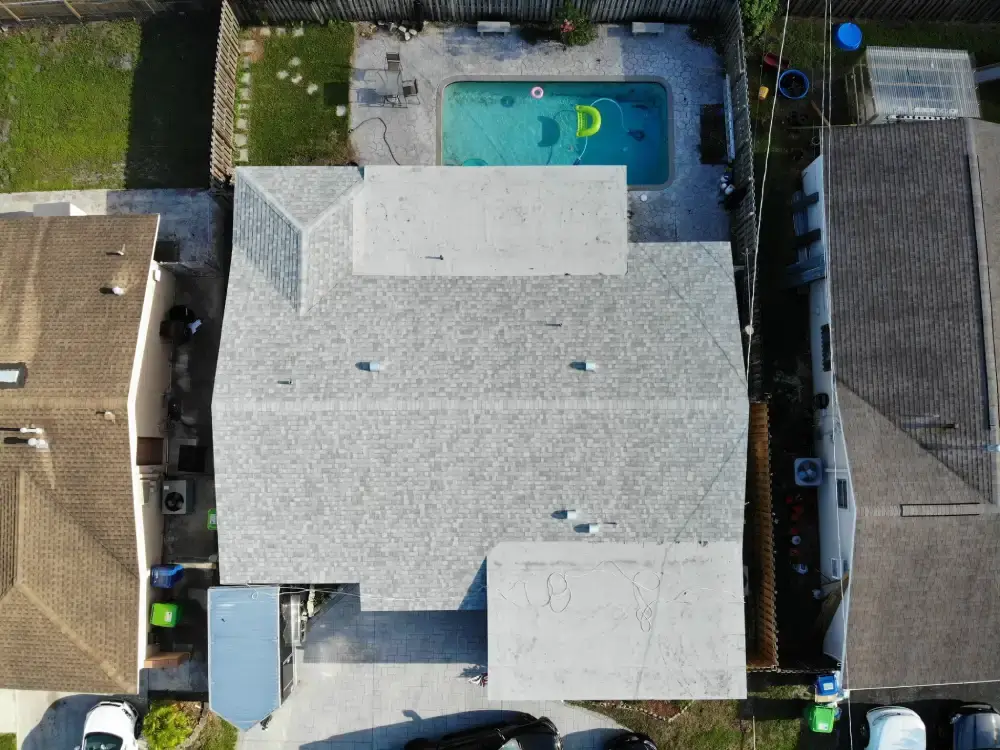
The failure mode on an exposed-fastener roof is slow and invisible, which is exactly why it gets ignored until the deck under a screw is soft. Ten years after installation, have somebody walk the roof and look at the washers. It is a short visit and it is the entire maintenance plan for that system.
Snap-lock, mechanically seamed and 5V crimp
Within standing seam there are two ways the seam gets closed. Snap-lock panels have a male and a female leg formed so that pressing the panel down engages them with an audible click, no machine involved. It is quicker, it costs less and on a residential roof at a normal pitch it performs very well. Mechanically seamed panels are set with the legs open and then folded shut by a machine that runs the length of the seam, producing either a single 90 degree fold or a double 180 degree fold. That folded seam is substantially more resistant to wind-driven water being pushed uphill into it, and it is what specifiers reach for on low slopes and severe exposures.
Slope is usually what decides between them and the numbers come from the product approval rather than from opinion. Snap-lock systems commonly require something around a 3:12 minimum pitch. Mechanically seamed systems, particularly double-locked ones, are commonly approved down to 1:12 and sometimes to half of that. That is the practical reason a mechanically seamed panel shows up on the low-slope wings of ranch houses and on contemporary homes with nearly flat roof planes, where no shingle or tile is permitted at all. Below the approved minimum for any panel you are looking at flat roofing instead, which is a different trade with different products.
Then there is 5V crimp, the traditional Florida panel with a pair of V ribs at each edge and one in the middle, fastened through the flat. It is an exposed-fastener system with all the obligations described above, and it is also the honest right answer on a large number of houses: cottages, porches, carports, additions, garages, and any older home where a modern seam profile would look imported from somewhere else. Anyone who sneers at 5V crimp has forgotten how many of them are still keeping water out of Florida houses seventy years after they went on. Priced, permitted and installed correctly it is a proper metal roofing job.
- Snap-lock standing seam. Seams engage under hand pressure. Lower labor, excellent residential performance, commonly limited to roughly 3:12 and steeper.
- Mechanically seamed, single lock. A 90 degree machine-folded seam. More weather resistance than snap-lock and a step up in labor.
- Mechanically seamed, double lock. A 180 degree fold, the most water-resistant seam available and the one approved for the lowest slopes.
- 5V crimp. Exposed fastener, simple, historically correct on older Florida homes, and the least expensive route to a metal roof.
- R-panel and corrugated. Wide, economical exposed-fastener sheets. At home on carports, workshops and outbuildings more than on the front elevation of a house.
- The approval sets the minimum slope. Not the salesperson and not the internet. Ask what the approved minimum pitch is for the panel being quoted on your roof.
Gauge, panel width, and which system belongs on which house
Two specifications finish the picture. Gauge is thickness, and on steel the numbering runs backward so 24 gauge is heavier than 26. Aluminum is quoted in decimals, commonly .032 or .040 for residential panels. Heavier metal dents less, spans better and shows less waviness, and it costs more. Panel width is the other one: a 12 or 16 inch panel gives a tighter, more traditional look and shows less oil canning than an 18 or 20 inch panel, at the cost of more panels, more clips and more seams to install. Neither of these is a trick question. They are the levers that decide how the roof looks from the street in year twenty.
So which system belongs on your house. If you are staying long term, if the roof is prominent, if the slope is shallow, or if you simply do not want a maintenance obligation attached to the roof, standing seam is the straightforward answer and mechanically seamed is the answer when the slope is genuinely low. If the structure is a porch, a carport, a detached garage, an addition or a modest cottage, or if the alternative to an exposed-fastener roof is postponing the whole project, then 5V crimp or an exposed-fastener profile is a sound decision that you can defend to anybody. Houses in the newer parts of Coral Springs and houses in the older coastal blocks frequently land on opposite sides of that line for perfectly good reasons.
Two things sit outside this comparison and both change the answer. The first is wind: the uplift performance of either system belongs to the tested assembly rather than to the panel, and that is the subject of what a metal roof wind rating actually means. The second is salt, because near open water the metallurgy of the panel and every fastener in it outranks the seam design, which is covered in salt air and metal roofs. Both are worth reading before you sign anything. When you want the systems compared on your actual roof rather than in the abstract, our measurement, roof report and written estimate are free, and you can book that visit or call 954-893-2550. What a complete job includes is written out on our metal roofing page.
- Long-term hold, prominent roof. Standing seam. No exposed rubber, nothing to service, and the appearance holds up.
- Low slope below roughly 3:12. Mechanically seamed standing seam, or a flat roof product. Snap-lock and exposed fastener are commonly not approved there.
- Porch, carport, garage, addition. Exposed fastener or 5V crimp. Right scale, right cost, right period detail on an older house.
- Tight budget, real need now. An exposed-fastener roof installed correctly beats a standing seam roof you postpone for three years.
- Heavier gauge on big visible planes. 24 gauge steel or .040 aluminum, with striations, on any large plane the street can see.
- Ask for both prices in writing. There is no reason an estimate cannot show you the same roof two ways, and the comparison is more useful than any article.
Frequently asked
Is standing seam always better than an exposed-fastener metal roof?
Better at a specific set of things, not universally better. Standing seam has no fasteners through the panel face, handles thermal movement on floating clips and needs essentially no maintenance, which is why it commonly reaches 40 years and beyond. An exposed-fastener roof costs meaningfully less and performs well, provided you accept a fastener service interval. On a porch, addition or modest cottage it is frequently the more sensible choice.
How often do the screws on an exposed-fastener metal roof need replacing?
Plan on having them inspected somewhere around the 10 to 20 year mark, sooner on hot unshaded planes. Inspection is not automatic replacement: a crew looks for backed-out screws, cracked or extruded neoprene and fasteners driven at the wrong angle, and replaces the ones that have failed. Worn holes should get a larger-diameter screw rather than the original size driven back in.
What is oil canning and is it a defect?
It is the faint waviness you can see in the flat of a metal panel under low-angle light. It comes from stresses in the steel or aluminum coil, from an uneven deck and from normal thermal movement, and essentially no manufacturer warrants against it. It is cosmetic rather than structural. A heavier gauge, a narrower panel and striations rolled into the flat all reduce how noticeable it is.
Is 5V crimp a cheap roof?
It is inexpensive and it is not cheap in the sense of poor. It is an exposed-fastener system with the fastener maintenance that implies, and it has been keeping water out of Florida houses for generations. On a cottage, a porch, a carport or an addition it is often the correct choice aesthetically as well as financially. On a large prominent roof where you want zero maintenance, standing seam is the better fit.
What slope do I need for a standing seam roof?
The product approval for the specific panel sets it, not a rule of thumb. Snap-lock systems commonly require something around a 3:12 minimum. Mechanically seamed systems, particularly double-locked seams, are commonly approved down to 1:12 and occasionally lower. Below the approved minimum for any panel on offer, the correct product is a low-slope membrane rather than a metal panel installed out of its approval.