

Cracked and Broken Roof Tiles: When to Worry and What to Do

You notice it after a windy night, or from an upstairs window, or because a neighbour mentions it. A tile on the front slope is cracked clean across, or one has slipped out of course and is sitting an inch low. Nothing is dripping inside, the ceiling is dry, and the temptation is to file it under things to deal with eventually. That is the correct instinct about urgency and the wrong one about consequence, because what a broken tile does is not flood your house. It opens a window onto the layer that actually keeps water out, and then the Florida sun goes to work on it.
The thing most homeowners never get told is that the tile is not the waterproofing. Concrete and clay tile are a durable, heavy, handsome shield that takes the impact, the ultraviolet and the wind. Underneath it is an underlayment membrane, and that membrane is the roof in the sense that matters. A tile roof in South Florida commonly outlives two underlayments. So a cracked tile is a hole in the shield, and the clock that starts is the one running on the membrane in that spot.
The other thing worth knowing before you get a quote is that tile repair is a different trade from shingle repair. Reaching the damage breaks more tile. The profile you own may not have been manufactured in fifteen years. The hip and ridge you are looking at may be mortared, foamed, or mechanically fastened, and each of those is repaired differently. Here is how all of it actually works, and how to tell the difference between a tile you can have replaced on a Tuesday morning and a signal that the layer underneath has finally run out of years.
The short version
- Foot traffic causes most cracked tile in South Florida, and most of it is not the roofers
- Tile is a shield, not the waterproofing; the underlayment beneath it is what keeps the house dry
- A cracked tile exposes underlayment to ultraviolet light, which is what turns it into a leak later
- Discontinued profiles are matched from salvage stock or blended from an inconspicuous slope
- Widespread slipped tile and repeat leaks on different slopes usually mean underlayment, not tile
Why tile breaks, and why walking it is usually the cause
Concrete and clay tile are strong in the way an arch is strong: they carry load through their shape, distributed to where they bear. Put a boot in the middle of an unsupported span and the tile takes a point load it was never designed for, and it cracks, often without any noise and often without anything visible from the ground. This is why crews who work tile every day step only on the lower third of a tile, directly over the head lap of the one below, where the tile is supported by the course underneath. It is also why they carry foam pads and walk planks on steeper or more brittle roofs.
The people who break the most tile are not roofers. They are the air conditioning technician who took the fastest route to the condenser stand, the satellite installer, the painter, the gutter cleaner, the pressure-washing outfit dragging a hose across a hip, and the pest control tech at the vent. Every trade that walks a Florida roof leaves tile behind, and most of them will never tell you. If you have had anyone on the roof in the past year and you now have cracked tiles on the path between the ladder and the equipment, you have found your cause.
The rest is weather and time. Wind lifts a tile that lost its fastener and drops it on its neighbour. A palm frond or a branch comes down. Debris driven at speed chips an edge. Older mortar-set tile loosens as the bed cracks and the tile begins to move a little every time the wind blows, wearing at the tile above it. None of these needs a hurricane. A strong summer afternoon does it.
- Step over the head lap, on the lower third. That is the supported part of the tile. Anywhere else is a gamble, and on clay it is barely a gamble at all.
- Other trades are the main culprit. HVAC, satellite, solar, painting, gutter and pressure-washing work all put untrained feet on your roof.
- Never pressure wash a tile roof carelessly. The wand pressure can drive water under the tile and the hose drag cracks edges. Cleaning tile is a low-pressure job.
- Slipped is different from cracked. A tile sitting low has lost its fastener, its foam or its mortar and will keep moving until somebody re-secures it.
- Do not walk it yourself to look. The inspection would cost you more tile than the original problem. This is what a ladder and a camera are for.
A broken tile is not a leak yet. It is a countdown.
Water that gets past a broken tile lands on underlayment, which is doing exactly what it was designed for, and runs down to the eave. This is why you can have three cracked tiles for two years and a perfectly dry ceiling, and it is the single biggest reason tile damage gets ignored. The house gives you no feedback at all until the day it gives you a lot.
What is actually happening in that gap is ultraviolet exposure. Underlayment, whether it is an older organic felt, a modern synthetic or a self-adhered modified bitumen membrane, is formulated to live in the dark under a covering. Exposed to direct Florida sun through a missing tile it embrittles, loses its granule surface or its plasticisers, and eventually cracks at exactly the point where water concentrates. Add wind-driven rain reaching a lap that no longer has a tile shielding it, and you have the mechanism. How fast depends on the membrane and the exposure, but months rather than years is realistic on a south or west slope.
There is a second cost that homeowners rarely price in. A cracked tile leaves fragments, and fragments migrate downhill into valleys and gutters where they dam water. So one broken tile at the ridge can produce a valley problem two slopes away. If you want the wider picture of how water actually finds its way in on a Florida house, the map of common leak locations is the companion to this post. The short version is that a prompt tile repair is cheap and a delayed one frequently is not.
- The dry ceiling is not reassurance. It means the underlayment is still working, which is the layer you are currently exposing to the sun.
- Months, not years. An exposed membrane on a hot slope degrades far faster than the same membrane under tile.
- Fragments travel. Broken pieces slide into valleys and gutters and dam water where it was already concentrating.
- One missing tile invites wind. The gap lets pressure under the neighbouring tiles and starts lifting them too.
- Cover it if a storm is coming. A temporary cover over an open gap is legitimate mitigation, and how to do that without breaking more tile is in our emergency tarp post.
- Photograph and date it. If the cause was a storm or another trade, when you noticed it matters later.
Matching a discontinued profile and a faded colour
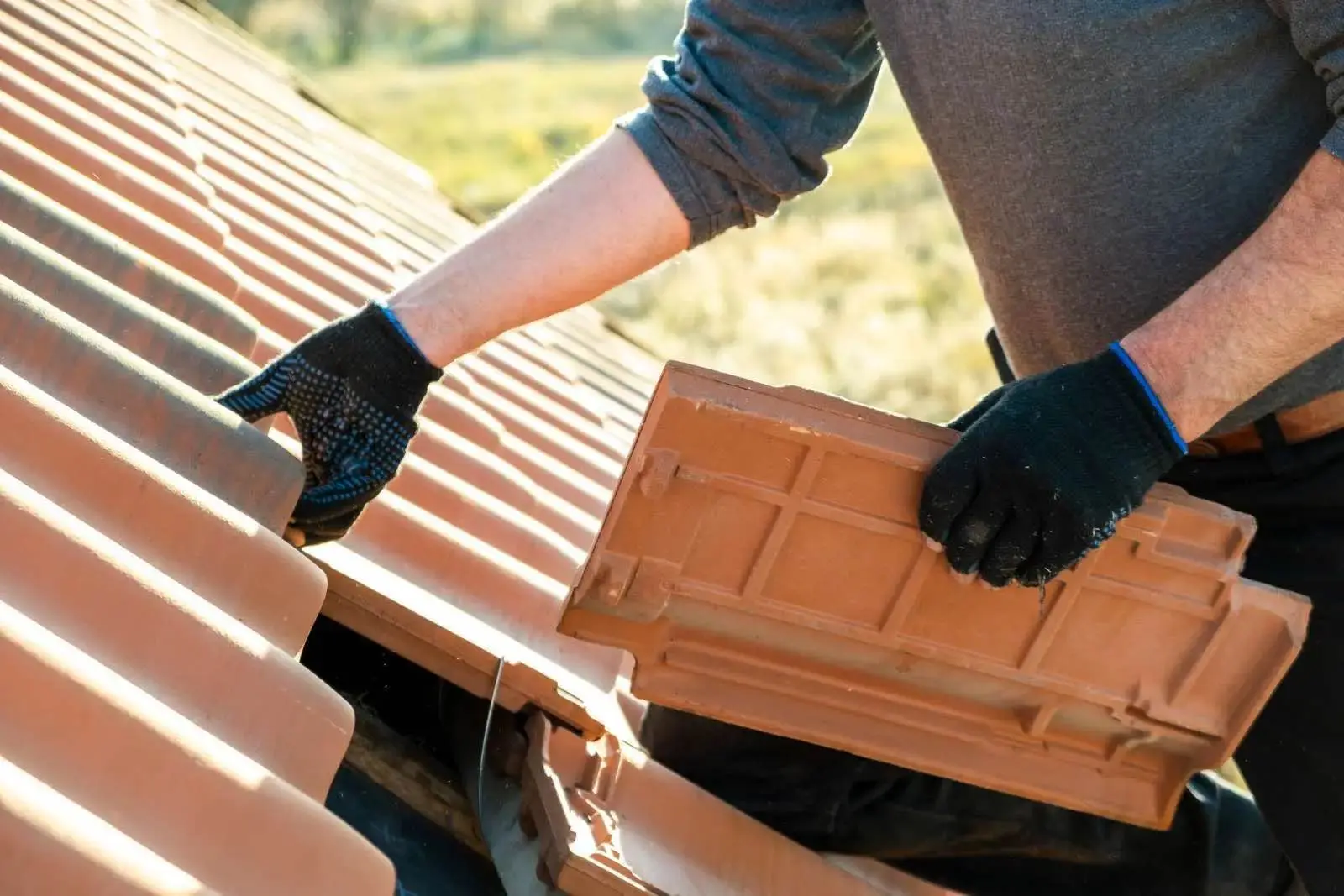
Tile is made in profiles: flat or slate-look, low-profile S, and the deep barrel that most people picture when they think of a Florida roof. Within each profile every manufacturer has its own dimensions, its own lug and nail-hole layout, and its own colour range, and manufacturers discontinue lines regularly. A roof installed in the early 2000s frequently has a profile nobody makes now. That is the normal situation on a tile repair, not the exceptional one, and a shop that works tile has a plan for it.
The plan is usually one of three things. First, the attic or the side yard: many tile roofs were installed with a small stack of spares left behind, and if yours has them the problem is solved. Second, salvage. There are yards and brokers across South Florida that hold obsolete profiles pulled from tear-offs, and a good roofer knows who has what. Third, cannibalising your own roof, meaning taking sound tiles from a rear slope or a hidden section, using them for the visible repair, and putting new or salvaged tile where nobody looks. That last approach is the reliable way to get a perfect front-elevation match.
Colour is the other half of it. Concrete tile is pigmented near the surface and softens with two decades of sun, so a tile straight off a pallet in the original colour will still look newer than its neighbours. Clay is fired through the body and holds colour far better, which is one of the real arguments for it. Where a match cannot be found, a colour coating or slurry applied to the repair area is a legitimate option, and so is deliberately distributing a few replacement tiles across the plane rather than clustering them. Our tile roofing page covers the material differences, and if you are still choosing, the three-material comparison goes deeper.
- Salvage yards hold obsolete profiles. Ask your contractor whether they source salvage, because the ones who work tile daily know where it lives.
- Borrow from a hidden slope. Take matched tile from the back of the house for the visible repair and put the new stock where nobody sees it.
- Expect a colour difference on concrete. Twenty years of Florida sun cannot be bought off a pallet. Clay ages far more gracefully.
- Scatter, do not cluster. A few replacement tiles spread across a plane read as normal variation. Four in a block read as a patch.
- Ask what the tiles cost before the visit. Sourcing time is real labor, and the pricing logic behind all of it is in our repair cost breakdown.
Mortar, foam and mechanical fastening at hips and ridges
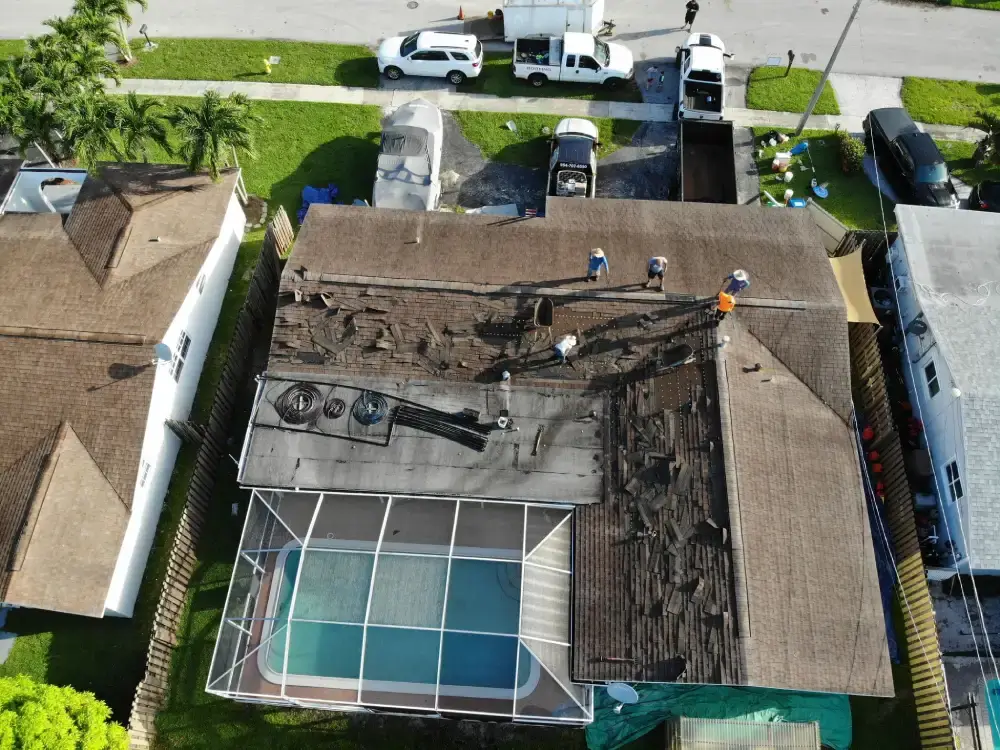
How your tile is held down tells you a great deal about the roof and about what a repair will involve. In the field, tile is typically nailed or screwed through its nail hole into the deck or a batten, sometimes with clips at the perimeter and in high-uplift zones. Older South Florida roofs also used mortar set directly on the underlayment, which works until the mortar cracks. Newer work commonly uses a two-part polyurethane foam adhesive, which bonds well, weighs almost nothing and holds uplift impressively, and which has to be cut and cleaned off properly when a tile is removed.
Hips and ridges are their own subject. The traditional South Florida detail is a mortar bed with the hip and ridge tiles set into it, sometimes with twin-wire reinforcement. Mortar is rigid and the structure is not, so over years of thermal movement the bed develops cracks, chunks come loose and the ridge starts shedding pieces into the valleys. Re-pointing a mortared hip is priced by the linear foot and is one of the more common tile repairs we do. The alternative, now widely used, is a mechanically fastened hip and ridge system: a nailer board running the length of the hip, with the tiles screwed to it and a weatherblocking closure underneath. It moves with the building instead of fighting it.
In Broward and Miami-Dade all of this sits inside the High Velocity Hurricane Zone, where the tile, the fastening method and the underlayment each carry their own Florida Product Approval or Notice of Acceptance, and the attachment schedule comes from those documents rather than from habit. That matters on a repair: a mixed assembly using whatever was on the truck is not an approved system, and permitted repair work in Coral Springs or anywhere else in the county gets inspected against the approval.
- Nails or screws through the nail hole. The baseline field attachment, into deck or batten, with clips where uplift demands them.
- Mortar set. Common on older roofs. Rigid, heavy, and it cracks with movement. Repairs mean cutting out and rebuilding the bed.
- Polyurethane foam adhesive. Strong, light and fast, and it must be fully cut away and the surface cleaned before a tile is re-set.
- Mortared hip and ridge. Re-pointing is priced per linear foot and is one of the most common tile repairs in South Florida.
- Mechanically fastened hip and ridge. A nailer with screwed tiles and a closure. It accommodates building movement instead of cracking.
- Product approval governs the fastening. Inside the HVHZ the attachment schedule comes from the approval documents for your specific tile and underlayment, and an inspector reads them.
Mortar at a hip or ridge is a weather closure and a bedding material, not a waterproofing layer. When it cracks, water reaches the underlayment beneath, which is exactly where it was always going to end up. Re-pointing restores the closure, and if the membrane under it is finished, re-pointing buys you very little.
Cosmetic tile problem, or underlayment problem
This is the question that decides whether you are spending hundreds or five figures, and there are reliable signals. A cosmetic tile problem is localised, has an identifiable cause, and sits on a roof with a dry attic. Three cracked tiles on the path from the ladder to the air handler, on a twelve-year-old roof, with clean underlayment visible in the gap and no staining anywhere inside, is a tile repair and nothing more. Fix it, note the date, move on.
An underlayment problem announces itself differently. Tiles slipping in multiple places rather than one, because the fastening substrate or the mortar has generally failed. Leaks appearing on different slopes within a season or two. Visible black staining, brittleness or exposed felt when a tile is lifted anywhere the technician checks, not just at the damage. Granules or membrane fragments washing out at the gutters. A roof past the twenty to twenty-five year mark, which is where a lot of South Florida underlayment starts giving up even though the tile above it looks like it could go another thirty years.
When that is the diagnosis, the answer is a re-lay rather than a repair: the tile comes off and is stacked, the old underlayment comes off, new membrane goes down to current requirements, and the same tile goes back with allowance for breakage. It is a serious job and it is far cheaper than buying new tile, and it resets the waterproofing clock on a roof whose expensive part is still perfectly good. We wrote that process up in detail in the tile underlayment re-lay post, which is the right next read if the signals above sound like your house.
- Localised and explainable means a repair. One cause, one area, dry attic, sound membrane where the technician looks.
- Slipping in several places means the attachment layer has generally failed, not that individual tiles were unlucky.
- Leaks on different slopes in the same season are an underlayment signal, not a coincidence.
- Membrane condition at the lift. Ask the technician to lift tile away from the damage as well and photograph what is underneath. That is the real test.
- Get it looked at properly. Free inspection, photographs, an instant roof report and a written estimate with permits included, plus $0 down financing if the number is a re-lay rather than a repair. Call 954-893-2550 or book a visit. The paperwork side matters too, since a documented, permitted tile repair is what your carrier can actually file.
Frequently asked
Does a cracked roof tile mean my roof is leaking?
Usually not yet. The tile is a shield and the underlayment beneath it is the actual waterproofing, so a broken tile normally leaves you dry for a while. What it does is expose that membrane to direct sun and wind-driven rain, which degrades it at the one spot where water concentrates. That is why a cheap repair now is meaningfully different from the same repair in a year.
Can you replace just one roof tile?
Yes, and it is routine work. The tile above is lifted, the fastener, mortar or foam holding the broken one is cut free, the piece comes out and a matching tile is set and re-secured. The complications are matching a discontinued profile and the tiles that break while reaching the damage, which is why a single-tile repair still carries a minimum visit charge.
What if my roof tile profile is no longer made?
That is the normal case rather than the unusual one. Roofers source obsolete profiles from South Florida salvage yards, use spares left in your attic or side yard, or take matched tiles from a rear slope for the visible repair and put new stock where nobody can see it. Expect a colour difference on any concrete tile that has spent twenty years in this sun.
Why does my tile roof have cracked mortar along the ridge?
Because mortar is rigid and your house moves. Thermal cycling and normal structural movement crack a mortar bed over the years, and pieces eventually work loose and slide into the valleys. Re-pointing is priced by the linear foot and is one of the most common tile repairs here. Mechanically fastened hip and ridge systems avoid the problem by allowing movement instead of resisting it.
How do I know if I need a tile repair or a full underlayment re-lay?
Look at the pattern rather than the tile. One area, one identifiable cause and a dry attic points to a repair. Tiles slipping in several places, leaks appearing on different slopes within a season or two, and brittle or stained membrane wherever a tile gets lifted point to underlayment. Age matters too: past roughly twenty to twenty-five years, ask about a re-lay before paying for repeat repairs.